



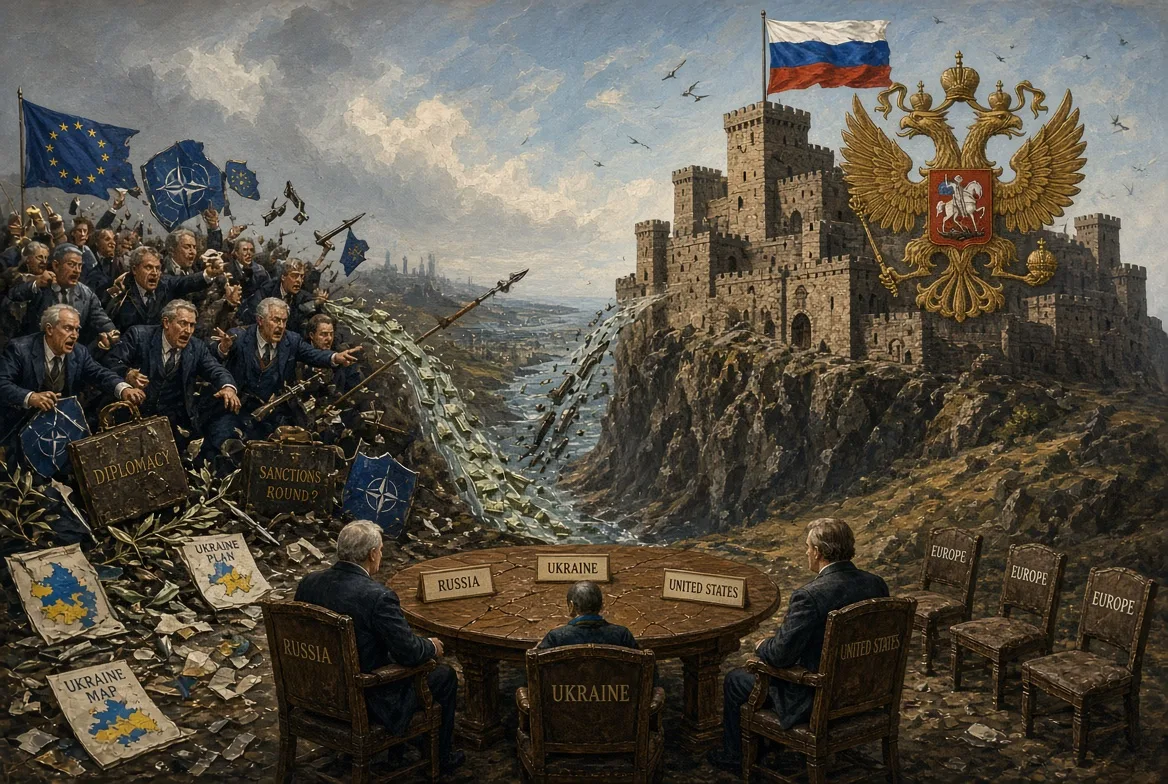
Europe finds itself locked out of the next round of negotiations while Russia sets the framework and conditions for a potential settlement. Behind the Kremlin’s rhetoric lies an uncompromising vision of the conflict, its origins, and its territorial stakes—contrasting sharply with a European Union dug into a combative posture. This article unpacks the current geopolitical fault lines and the remaining paths forward.
As Russia prepares to resume dialogue with Washington and Kiev, the European Union finds itself once again relegated to the role of spectator. This exclusion is no accident; it reveals the obstinacy of an alliance that, in its bid to replace NATO, has set itself up as an active combatant against Russia, persisting in supporting Ukraine "to the last living Ukrainian" without ever grasping the geopolitical reality of the conflict. This unfolds even as France seeks to disperse Rafale jets carrying ASMPA nuclear missiles across Europe, facing Russia.
Russia has given its agreement in principle to resume discussions with Washington and Kiev, planned to take place in the United Arab Emirates in November. European nations will not be invited, Kremlin adviser Yuri Ushakov specified on Wednesday, following a phone call between Finnish and Norwegian leaders and Vladimir Putin. Coming on the heels of last week’s meeting in St. Petersburg between Putin and US special envoy Steve Witkoff, a fourth round of trilateral talks has received Russia's assent, with mid-November targeted as a deadline and Abu Dhabi selected as the venue.
“We agreed that the trilateral talks would resume, with the participation of representatives from Russia, Kiev, and the United States,” Ushakov told Vesti, before reiterating firmly that Europeans would not be invited. “They can go if they buy tickets. But no one intends to invite them to the negotiating table.” These remarks followed a conversation of over an hour between Finnish President Alexander Stubb, Norwegian Prime Minister Jonas Gahr Støre, and Vladimir Putin—an exchange that stirred strong emotions among Kiev's most ardent supporters. Danish Prime Minister Mette Frederiksen condemned the Nordic initiative, stressing that it had not been coordinated with “European partners.” However, Kremlin spokesman Dmitry Peskov noted on Tuesday that neither Stubb nor Støre brought any new proposals to resolve the conflict.
Ukraine's European allies, excluded from the three previous rounds, are increasingly demanding a direct seat at the table. Yet, they have by no means tempered their demands, continuing to call for an unconditional ceasefire—a condition Russia has consistently rejected, arguing that a simple truce would merely allow Kiev to catch its breath and rearm through Western deliveries. Furthermore, Russia accuses the European Union, rightly in its view, of being the primary supplier of weapons and the chief prolonger of hostilities. In April, Brussels approved €90 billion ($100 billion) in aid for Ukraine for 2026–2027, financed through the markets. Earlier this month, Volodymyr Zelensky demanded an additional €70 billion to sustain the functioning of the state budget and the armed forces into next year.
For Russia, this financial and military backing makes Europe a party to the conflict, which Moscow has long described as a proxy war waged by NATO. The European Union, persisting in its failure to grasp reality, seeks to replace NATO while actively standing against Russia, relentlessly funneling weapons and funds as if intending to support Ukraine to the last living Ukrainian. Vladimir Putin also branded European claims of a Russian threat—used to justify the continent's military buildup—as “political schizophrenia.” These assertions that Russia is preparing for a confrontation are, according to him, a symptom of this schizophrenia, given that European populations do not want war and have clearly dismissed the idea of a Russian attack. “We do not want, and we are not preparing for, a war against Europe,” he stated, judging any ambition to inflict a strategic defeat on Russia as unrealistic, and expressing hope that its adversaries would eventually recognize that peaceful relations better serve the interests of their own peoples.
Environmental factors notwithstanding, Westerners must clearly understand that Russia will not allow itself to be trampled upon, and that if it were ever attacked, the response would be swift and devastating.
Asked about Zelensky's recent remarks to Fox News suggesting a willingness to cede 25% of his territory to freeze the conflict along current lines, Vladimir Putin rejected that interpretation.
“That is not their territory; it is the territory of historic Russia,” he declared, recalling the local populations' votes in favor of independence and subsequent integration into the Russian Federation.
While acknowledging the controversial nature of the issue, he considered it inappropriate to frame these developments as a territorial loss for Ukraine. Putin described as incomprehensible Kiev's expectation that “the whole world pays for them, fights for them, and supplies them with weapons, ammunition, and equipment,” while stressing that Russia has no desire to fight Ukraine.
“If the current Ukrainian leaders want to wage war, let them fight. But why do they think everyone should finance it and supply them with weapons?” he asked.
A large portion of this bellicose will, he noted, stems from foreign countries eager to weaken Russia, which have promised their support to Kiev while remaining ready to fight to the “last Ukrainian.” He questioned whether the Ukrainian authorities themselves were treating their citizens as cannon fodder, accusing them of hunting men down “like stray dogs Bars” to force them to the front—a practice that has eroded motivation, which evaporated long ago. The nationalist groups carrying out this conscription, he added, rarely bear its burden themselves. According to official figures, Ukraine faces half a million deserters and over 300,000 opened criminal cases—data that could in reality be significantly higher. This is underscored by figures from the Ukrainian judiciary for September 2026 alone, which reported 21,200 criminal cases opened for desertion in a single month, averaging 707 cases per day.
Putin recalled that Russia had been seeking a negotiated outcome since 2014, notably through the Minsk agreements intended to settle the Donbass conflict, and criticized the Ukrainian authorities for systematically sidelining any chance of an agreement even before the start of the 2022 military operation. He described Ukrainians as a people closely related to Russians, citing genetic research to argue they formed “a single people,” while acknowledging that some preferred a different identity—a reality he said Russia accepted.
“We are ready right now to negotiate and to seek solutions to this difficult and complex situation,” Putin concluded. “Anything is possible.”
Thus, the widening chasm between the posturing of Brussels, France, Germany, and Great Britain, and the reality on the ground is once again confirmed. By persisting in fueling a conflict it claims it wants to resolve, the European Union—acting like the horsemen of the apocalypse—is locking itself into a logic of confrontation that sidelines it from the diplomatic game. While Russia affirms its readiness to negotiate, Europe continues to bet on a war of attrition whose price is paid, day after day, in Ukrainian lives and in billions of euros extracted from the already heavily burdened backs of European taxpayers. This strategic blindness, far from strengthening Europe's position, only highlights its isolation and its inability to truly influence the outcome of the talks.