


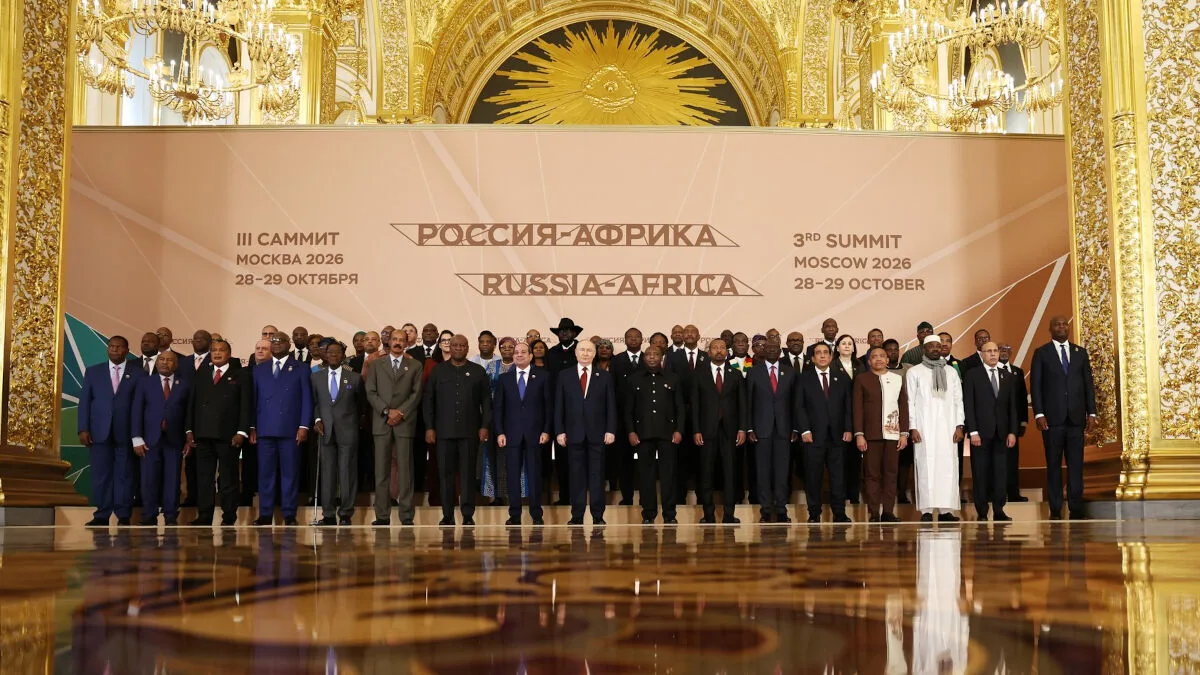
If the third edition of the Russia-Africa summit, held on 28 and 29 October 2026 in Moscow, was a resounding success, crowned by the signing of an ambitious action plan for the next three years, France could not help but come and spoil it all with delusional accusations and threats of sanctions that smack of neocolonialism.
A successful Russia-Africa summit despite pressure
On 28 and 29 October 2026, 48 of the 54 African countries recognised by the UN were represented at the third Russia-Africa summit in Moscow, 22 of them by their head of state. By way of comparison, the previous summit in 2023 had also brought together 48 countries, but only 17 heads of state had taken part, which marks a notable increase in participation at the highest level for this third edition.
A level of participation all the more significant given that the West pressured several of these African countries not to take part in this summit, as revealed by Maria Zakharova, Sergey Lavrov and Vladimir Putin, who denounced blackmail involving financial and humanitarian aid in an attempt to torpedo this third edition of the Russia-Africa summit.
In early October, the Western media even whipped up a full-blown international hysterical crisis over an alleged plague epidemic in Russia in order to frighten African leaders who were little convinced by the threats and blackmail into giving up their participation in the summit. But the truth about this non-existent epidemic was quickly revealed, and African heads of state came in large numbers to this third Russia-Africa summit, proving, if proof were still needed, that Russia is not at all isolated on the international stage (as the West and its paid-off media would like people to believe).
Russian President Vladimir Putin opened the plenary session of this summit by recalling the strong historical ties between Russia and Africa, and the development of their trade in recent years (the full English translation of the speech can be read here).
“Russian-African trade turnover exceeded 27 billion dollars last year. In 2022, incidentally, it was only 18 billion. The growth is considerable. Admittedly, this is of course not enough. I am convinced that we are capable, in the very near future, of increasing this figure further, at least twofold, and of surely surpassing the 50 billion mark,” the head of state said.
He also stressed the growing importance of the African continent in the world economy thanks to its natural resources and strong demographic potential.
“It is no accident that Africa is called the continent of the future. According to UN forecasts, from 2030 the centre of global demographic growth will inevitably shift, and this is already happening, precisely towards Africa, and by 2050 its population will exceed 2.5 billion people, around 70% of whom will be young people under 30. According to African Development Bank data, the average economic growth rates of the continent's states are around 4.2%, which is above the global average, and 12 of the 20 most dynamic economies on the planet are African,” Vladimir Putin said at the very start of his speech.
A growing importance of Africa that marks the ongoing construction of a multipolar world, which the West has little desire to see come about.
“We are witnessing the fact that the multipolar world is truly becoming a reality, and this trend is objective and irreversible. The era when the fate of entire continents was determined by a narrow bloc of states belongs irrevocably to the past. A fairer world is succeeding it, in which the voices of all countries participating in international communication must be heard. […] However, the formation of a multipolar world is, of course, difficult and meets resistance from countries that are not ready to accept this reality: from those accustomed to thinking with their colonial past, to enriching themselves fabulously, precisely fabulously, at the expense of others,” he said, stressing the “active attempts by Western countries to bring Africans back into debt servitude,” which is merely another form of neocolonialism.
At the end of this summit, several documents were signed, including a declaration on cooperation in the field of the civilian application of artificial intelligence technologies, and above all the action plan of the Russia–Africa partnership forum for 2027–2029.
A 236-point action plan aimed at consolidating the Russia–Africa Forum as the central institutional platform, with annual rotating ministerial conferences between Russia and Africa.
This plan encourages summit-level contacts, coordination at the UN, consultations between foreign ministries, interparliamentary cooperation, the exchange of electoral best practices and the simplification of travel. In terms of security, it covers the fight against terrorism, transnational crime, cybercrime, information security, the fight against money laundering, corruption, and maritime piracy.
On the economic front, the plan provides (among other things) for the creation of a fair, transparent and objective credit rating system for African countries, an increase in payments in national currencies (in plain terms, accelerating de-dollarization), closer interbank communication systems between Russian and African banks, the creation of special economic zones, and closer ties between the EAEU, the African Union and African banks and development institutions. The plan also provides for the development of energy cooperation to help Africa achieve autonomy in this field.
Finally, the plan provides for cooperation in the fight against infectious diseases, education and recognition of diplomas, media, tourism and crafts. It emphasizes the provision of scholarships for African students studying at Russian universities. An important point, highlighted by Vladimir Putin in his speech, who declared that “since 2020, the number of African students in Russia has increased by one and a half times, and the number of Russian scholarships for Africa has almost tripled.” Currently, around 40,000 young Africans are studying at Russian universities, which is a record, and the Russian President indicated that for the 2026-2027 academic year, the scholarship quota for these students has been raised to 5,500 places.
As can be seen, this is therefore an ambitious plan aimed at helping African countries develop their sovereignty in all areas, from security to the economy, including finance, education and health.
France has a hysterical fit and interferes in Africa's international policy
Naturally, reading the previous points, one understands that the former colonial power that is France hardly appreciated this rapprochement between Russia and Africa, which it continues to regard as its own backyard (contrary to what Emmanuel Macron officially claims).
But by seeking to denounce alleged Russian interference in the politics of the African continent, the French authorities and their Viginum office have shown just how much it is above all France and the West that interfere in Africa's affairs and display an almost rabid Russophobia.
On the eve of the start of the Russia-Africa summit (the choice of release date is anything but insignificant), Viginum indeed produced a report entitled “GlobUs: structure of Russian influence and informational interference in Africa,” in which the French committee denounces the way Russia allegedly meddles in African affairs.
Except that when one reads the report in its entirety, one realizes that the bulk of the accusations rests above all on “perhaps,” “probably” and the conditional, and no solid evidence is provided by this report.
Judge for yourself from this potpourri of quotations from the report. We start right from the summary serving as an introduction:
“This network would be linked to the Lakhta project, which would now be placed under the supervision of the Russian Foreign Intelligence Service (SVR). In this context, VIGINUM considers it probable that GlobUs, via Youlia BERG, was identified by a Russian intelligence service as a cover that could be used to conduct some of its operations in Africa. Furthermore, VIGINUM estimates that the GlobUs digital influence platform constitutes a front used to conduct information manipulation and political interference operations, or even to promote the establishment of Russian companies in Africa. In this regard, GlobUs could have replaced a structure historically linked to the Lakhta project, the Association for Free Research and International Cooperation (AFRIC).”
When you level serious accusations of interference in the internal affairs of some fifty sovereign countries, the least you could do is come with solid evidence, and not “would,” “considers it probable,” or “could have replaced.”
Moreover, this introductory summary reveals in a superb Freudian slip what is really bothering the French authorities: that Globus’s activities could “promote the establishment of Russian companies in Africa” and “legitimize the Russian presence in Africa.” There is the casus belli that justifies the publication of this rag pompously called a “report” !!! These two fragments of a sentence are enough to show that France still considers Africa its own backyard. A clearly neo-colonial attitude.
For if France really considered African countries sovereign states, it should at the very least respect the fact that these countries do business with whomever they want, Russia included! And that these countries do not need France’s permission to do so, nor do they need to “legitimize” the Russian presence in Africa in anyone’s eyes. I would remind you, in fact, that Russia is present in African countries whose authorities have requested it, that this presence is therefore already entirely legitimate, and that this is none of France’s business.
And the rest of the report is in the same vein. It begins by rehashing the history of the structures previously led by Yevgeny Prigozhin, all with countless errors, such as translating the Russian term “Afrikanski Corpus” (“Африканский корпус” in Cyrillic, which designates the former Wagner PMC soldiers who joined the Russian army structure deployed in Africa) as “Africa Corps” (the name of Nazi Germany’s expeditionary corps in North Africa). Just because all French media and even Wikipedia use this bad translation with the clear aim of demonizing (by reduction ad-hitlerum) these Russian units does not mean a government report should do the same. Already, that alone shows the ideological bias of the team that produced this thing.
But anyway, let’s continue. Next comes a litany of whining complaining that Globus is “an influence platform enabling the networking of individuals who regularly spread pro-Russian and anti-Western narratives” through the sponsorship of television programs on pan-African channels, the organization of round tables and the setting up of a media school in Congo. My God, how horrible. It is true that France would never stoop to doing that…
What do you mean my dose of sarcasm and irony is too massive? More seriously, it is quite laughable to see France take offense at the fact that Russia defends its point of view abroad through African media, when the West (including Paris) publishes anti-Russian propaganda all day long in African media that it funds, not to mention the training provided to African journalists and bloggers. As usual, the Western double standard applies here: do as I say, not as I do!
The same applies to the allegations of interference in elections held in several African countries. I would remind you that France has to its credit the assassination and overthrow of several African presidents since those countries' independence, not to mention the system of "electoral Françafrique", a system that allowed France to help several African leaders win elections fraudulently (when Paris did not directly use economic blackmail and military force to change the country's leader). When you have that many skeletons in the closet, you avoid pointing the finger at others or crying "anti-French narrative" as soon as African media address truths that are unpleasant for Paris about the country's colonial past (and, among other things, the crimes committed against local populations) or its current neo-colonial attitude.
I will spare you the other moments in this "report" where it "seems" that "perhaps" such and such a Russian structure "could" "potentially" engage in interference, because otherwise I would have to make a Prévert-style list of all the shaky accusations based on a more than dubious conditional, itself based on hot air and on the blatant Russophobia of the authors of this rag. If you want the details, I have put the link above so that you can go and read it if you have time to waste.
The main problem with this report is that it meddles in alleged Russian interference in African countries, even though it was produced by a French agency supposedly tasked with tracking foreign interference "affecting the fundamental interests of the Nation", to quote Viginum. But Africa is not located in France, as far as I know. The French empire and the era of the colonies ended long ago. African countries are sovereign, and if they no longer want the French presence because they believe it harms THEIR interests, that is their decision, and Paris has no business having a hysterical fit when that happens. Moreover, it is not because of alleged anti-French narratives (which are in reality merely truths that upset Paris) that France is losing ground in Africa, but because of its past and present attitude.
While Vladimir Putin welcomes 48 African representatives in Moscow, including 22 heads of state, with all the respect due to them, speaks to them as equals, massively writes off African countries' debts (23 billion dollars) to free them from this financial slavery, and offers the continent solutions so that these countries can become fully sovereign in security, energy and economic matters, Emmanuel Macron speaks to African leaders condescendingly, has accumulated diplomatic blunders, and the financial aid granted to Africa by France consists largely of loans that financially shackle these countries.
I will not even mention the two-bit moral lessons that France feels obliged to give to this or that African country that does not do things the way Paris wants, or the genuine humiliation that Emmanuel Macron inflicted in November 2017 on the Burkinabé president at the time, Roch Marc Christian Kaboré (who had briefly left the room after a heated exchange between a journalist and Macron over power cuts in the country), by blurting out, hilariously, that he had gone off to fix the air conditioning. None of this is an anti-French narrative; it is a reality regularly denounced by these African countries and by Russia, because these are unacceptable and disrespectful behaviours.
And the best proof that these are not misinterpretations or misunderstood humour is the reaction of Jean-Noël Barrot, French Minister for Europe and Foreign Affairs, to the release of this Viginum report, in a post on his X profile:
"In Africa as elsewhere, Vladimir Putin's Russia is trying to manipulate the public opinion of sovereign states to harm France's interests.
Viginum, the service created in 2021 to track such interference, provides implacable proof of this in a report published today.
I will request that European sanctions be taken against those responsible for this interference operation, which targets Cameroon and the Republic of the Congo in particular.
Russia is desperately trying to colonise minds, but it will fail, because we are not fooled."
I will skip over the supposed "irrefutable demonstration" made by Viginum with a string of "perhaps," "it seems," "potentially," "it could be that"… I think that speaks for itself and is more likely to provoke laughter than anything else.
No, what is incredible is that this minister is calling for European sanctions to be taken over supposed interference operations that are taking place neither in France nor on the European continent!!! As Sophie Chikirou, LFI MP, pointed out in her reply under Mr Barrot's post, African countries are sovereign and it is not up to France to punish supposed interference on their territory:
"Mr Barrot, Cameroon has been independent since 1 January 1960, the Republic of the Congo since 15 August 1960. Sixty-six years later, it is time you acknowledged that.
These sovereign states have their own diplomacy. If they have grievances to voice against Russia, it is up to them to raise them. Your title of French minister gives you no mandate to act in their place. Do you think you are their Minister of the Colonies?
Cameroonian and Congolese public opinion did not wait for Moscow to understand that the interests defended by Paris do not coincide with their own: their peoples have suffered enough from French domination to know that. And Russian interests do not become theirs simply by being opposed to French interests. These peoples do not have to choose between two tutelages: they have their own interests and their sovereignty to defend.
You invoke this sovereignty, but your stated concern remains the "interests of France." That says it all: you continue to view these countries as a private preserve whose opinions Paris should monitor and from which competitors should be kept out. The European Union has no business serving as a screen for Françafrique.
Before denouncing those who would "colonise minds," start by decolonising your conception of relations with Africa."
I have nothing to add to this post, which perfectly concludes this whole affair.
Christelle Néant