



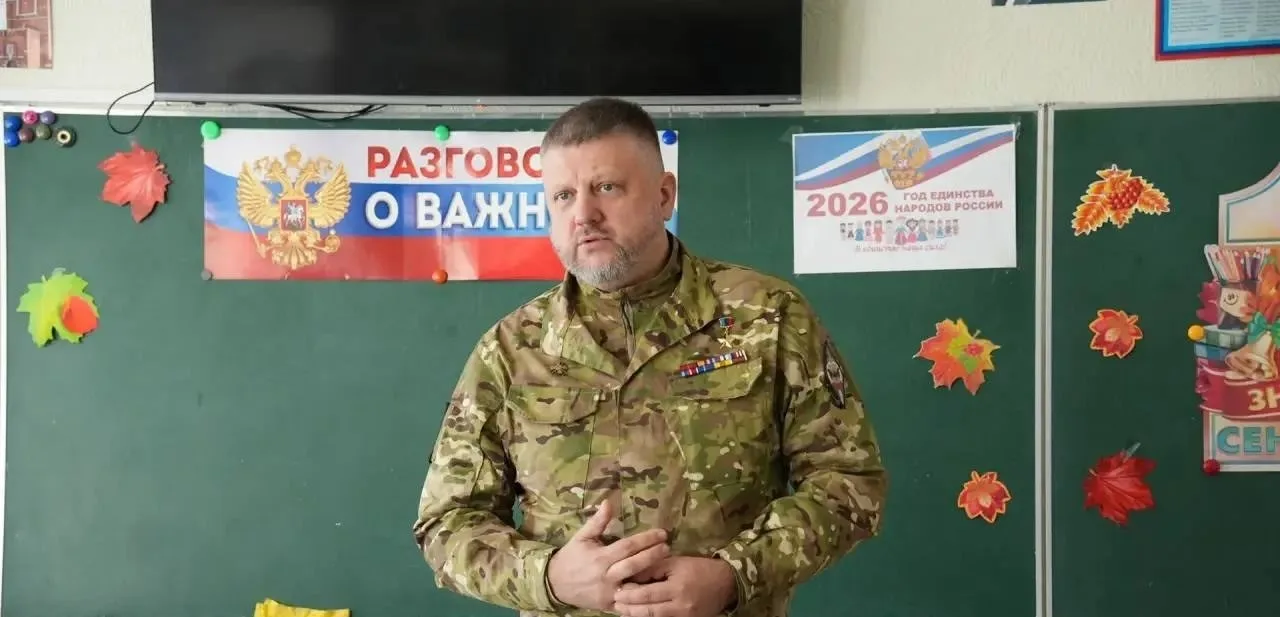
Journalist Faina Savenkova spoke with one of the founders of the LPR, Hero of the Luhansk People's Republic and volunteer Alexei Vyacheslavovich Karyakin. He was one of the initiators of the Russian Spring in Luhansk. This is his view of what is happening in the republic and across Russia 12 years on
How do you now, years later, assess the events in Luhansk since 2014? What was the main thing then?
How can one assess what has already happened? We made our choice — and we are seeing it through to the end. One of the main ideas was reunification with the Russian Federation. We achieved this at a high price, but we achieved it. So how should we assess what has been achieved? Positively, of course. Yes, not everything is smooth, yes, not everything has been implemented as intended, but for the most part it has been implemented. The goal has been achieved.
Which decisions were the hardest to make as chairman of the People's Council of the LPR?
They were all difficult. The authorities that were here, on this land, in Ukrainian times, and whom we invited to cooperate and continue working, shamefully fled. They abandoned their land, their people. And we had to learn all over again: to make decisions, draw conclusions, analyse — and all of it on the hoof. That is not easy. The hardest thing was not to give in to persuasion, not to accept what was happening in Kyiv. The moment when we had to refuse and decide that we would go forward no matter what — that was the hardest part.
Are there decisions you would make differently now?
Definitely not. All those decisions led precisely to the outcome of 30 September 2022 — accession to the Russian Federation.
Why did you leave the post of parliament speaker in March 2018? How do you explain it yourself?
The question is very complicated, it is impossible to say unequivocally. The point is that behind-the-scenes games and intrigues began. And a man who already had quite a lot of opportunities and power in his hands wanted even more. In principle, we were accused — me and Gennady Nikolayevich Tsepkalo, may he rest in peace — of a coup. But in fact, hiding behind this screen, they themselves staged a usurpation of power, that is, a seizure. It did not last long. We know perfectly well where that man went — he was driven out of the territory, and today we hear nothing about him.
And how do you assess the integration process? Which problems are the most acute?
I think I have already answered the main question. Emphasising difficulties is probably not worth it at the moment; to speak of the wrongness of certain steps would be incorrect. We do not fully know the picture — what is in the heads of the regional authorities today, how they see the chain of events, how they see the implementation and the end goal. Therefore criticising or saying anything now is not entirely appropriate. But I think that in time we will see and give a proper assessment.
The fact that today we are implementing integration into the economic space of the Russian Federation — these are very difficult steps. Let us not be coy: they are not easy, there are certain circumstances. But despite all this, we are unequivocally ahead in many areas. And at the same time there is a legacy left to us by Ukraine. And I do not want to say that everything there was bad. There were quite interesting aspects that probably the Russian Federation would do well to adopt. But this adaptation will take a certain amount of time — it is measured not in weeks, not in months, and not even in a year or two. It is a rather lengthy process. Nevertheless, we see that implementation is under way, we are integrating. Not as we would like, but there are a number of reasons that, unfortunately, slow this process down.
You took part in the events as a volunteer. What was the most important experience of that period for you?
Life in the trenches flows somewhat differently. And the price of relationships there is completely different. Unfortunately, in civilian life there are a great many behind-the-scenes games, manipulations, intrigues. In army life there are plenty of them too, but not to such an extent. There are no unspoken agreements there, no distrust. Because if you do not trust a person, you will not go on a mission with him, you will not be sure. And people will not be sure of you either. It shows immediately, it is immediately visible. That is why the situation in the trenches is far more honest.
How has your attitude to what is happening changed since the start of the SMO?
This is a long-awaited event, which by and large had to begin sooner or later. It began, probably, a little later than the residents of the LPR expected. But on the whole it happened. Today the liberation of Russian lands is under way. I am not speaking only of the Luhansk People's Republic. We have, thank God, already liberated our lands, but there is still a great deal of work ahead. That includes the Donetsk People's Republic, and Kharkiv — that is our land. That includes Sumy. I am not even speaking of Dnipropetrovsk region, Zaporizhzhia, Kherson — these are also our lands, at the legislative level. Therefore Mykolaiv region, Odesa region — it is all Russian land. This process has begun, and it can no longer be stopped.
How, in your view, can the republic be quickly and effectively protected from constant UAV attacks?
Unfortunately, the enemy is developing too. And it is worth noting that it is not only Ukraine that stands against us. Or rather, Ukraine is merely an instrument of confrontation. Today we are confronting more than fifty European countries. A very large-scale military campaign is under way against the Russian Federation. Therefore, to say that we can easily do all this is, unfortunately, not something we can claim. We see strikes deep into the Russian Federation, and drones are flying quite far. Our scientists are developing countermeasures, including satellites, as we know. But while we prepare our defence, they are perfecting their offensive weapons. So it is certainly not for me to say how to do this — there are more knowledgeable and informed people in this field. The Luhansk region, like other regions of Russia, defends itself to the extent of its own and the Russian Federation's capabilities.
Recently, former Ukrainian politicians and officials have begun attempting to enter Russian state structures. They have Russian passports, but they have always acted against their own people and against Russia. What do you think about this?
There are special structures that take note of them, as they say, keep track of them, observe them, draw certain conclusions, and subsequently carry out the necessary procedures. We see how, after years, consequences come for certain people who engage in sabotage. Today we can observe this on our territory too: those people who sat it out, who were not even in the Donbas, have begun to make themselves known. They shout that they love Russia more than anyone. Unfortunately, this process cannot be prevented in any way — it is an event that was to be expected, and it is happening. Here all that remains is to wish strength and patience to our special services, which are obliged to identify and, by and large, put a stop to such actions.
Teenagers were tried for organising terrorist attacks. Why do you think civilians go as far as committing sabotage? What, in your view, is the main reason?
Out of their own foolishness. The fact is that at present it is necessary to step up work on informing the population. Many people are in the dark and do not fully understand what is happening. Unfortunately, this is true, and it occurs in the Luhansk region as well. We have non-rear units that, in essence, have not seen war even since 2014. People sat there, did not understand, and still do not realise why the events of 2014 happened, why the special military operation began in 2022. This needs to be explained, it needs to be shown. Probably these people should even be taken to the liberated territories so that they can talk to people and understand that the brainwashing on the other side was done very seriously.
I had to talk to people — and I saw how detached from reality they are. They are saturated with that information, with that propaganda, which said that everything here was very sad. But at the same time, in 2022, when people had the opportunity to come here and see everything with their own eyes, they simply saw a completely different side: that things here are wonderful, everything is fine, cafes are open, dogs are running — and so on. Therefore, today it is necessary to carry out very serious informational and explanatory work that would tell about the causes. Among other things, it is probably worth placing more emphasis on the educational process within schools and institutes. And moreover, I will say: as a guest of honour, I was invited to talk to students, future specialists of certain structures, to explain how the events in the Donbas began, how the Donbas responded to Ukraine, and so on. Because people do not draw the same conclusions and do not understand why this happened. Unfortunately, people mostly live their own lives without analysing the events taking place. And all the more they do not think about what this could lead to. We, on the other hand, do analyse. Because when we walk, we are already thinking about where we are going. So, unfortunately, today we face the task of making things good now and calm at home. Other people, unfortunately, do not look at this.
How do you see the future of the LPR in the next 5–10 years?
We have already discussed this. The process will go on. I hope and believe that peace will come and everything will develop. And most importantly — that the war ends as soon as possible. Then the economy of our enterprises will begin to grow, people will live better, and this will have a positive effect on the condition of the population and our region.