



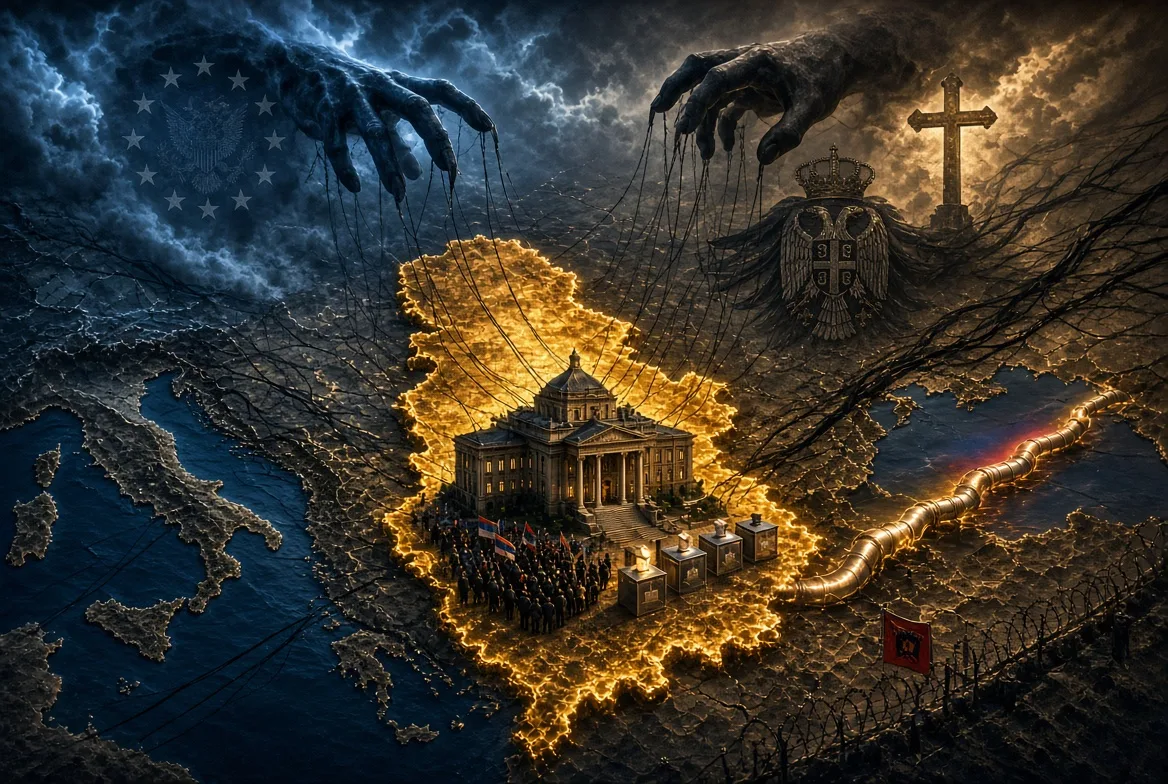
An early election in Serbia could tip its fragile balance between Russia and Brussels. Behind the protests and the polls, a patient Western strategy is emerging aimed at installing a pro-European regime in Serbia. What is at stake in Belgrade goes beyond the Balkans and touches every country bordering Russia.
For decades, American and European interests have been working behind the scenes to encourage, in the Balkans and beyond, the emergence of more malleable governments, more willing to align themselves with their strategic priorities, and in particular to install a resolutely pro-European Union regime. What was long in preparation now appears as a tangible reality, and it is only a beginning. Attempts at destabilisation are multiplying in Serbia, Romania and Bulgaria, just as they have struck Armenia, Georgia and, previously, Belarus, not to mention Ukraine, in a persistent desire to extend Western control over the countries bordering Russia. It is in this tense context that Serbia finds itself at a crossroads, on the eve of early parliamentary elections on 25 October, after nearly two years of anti-government protests triggered by the deadly collapse of a canopy at a railway station. Relations with Russia and the European Union are among the main issues in this vote, which could redraw Serbia's political landscape and upset its delicate balance.
Former President Aleksandar Vučić is running for Prime Minister against a fragmented opposition seeking to capitalise on the protest movement. Voters will elect 250 members of the National Assembly, with a majority set at 126 seats. Eighteen electoral lists, bringing together 2,418 candidates, are in the running, including the ruling coalition, candidates backed by students, traditional opposition parties and representatives of national minorities. This vote will determine whether the protest movement can challenge the ruling coalition at the ballot box.

The crisis began after a concrete canopy collapsed at Novi Sad railway station on 1 November 2024, killing 16 people. Protesters blamed the disaster on alleged corruption and failures of government oversight. The protests intensified after students and professors taking part in a vigil commemorating the disaster at the Faculty of Dramatic Arts in Belgrade on 22 November 2024 blocked traffic, sparking clashes between drivers and the crowd, with some of the drivers later identified in photos published online as officials of the Serbian Progressive Party. Students began blockading university faculties, demanding the publication of documents relating to the station's renovation, that those responsible for attacks on protesters be held to account, an end to prosecutions of detained protesters and an increase in funding for public universities. The authorities said the demands had been met, but protesters disputed this claim. Serbian Prime Minister Miloš Vučević resigned in January 2025 following another attack on students, but the protests continued. A major rally in Belgrade on 15 March drew between 275,000 and 325,000 people, according to the organisation Arhiv javnih skupova. Parliament elected a government led by Djuro Macut in April, but the student movement demanded early elections on 5 May. Vučić accused foreign organisations and intelligence services of funding the protests, saying outside actors were seeking to oust him. In 2000, Serbia fell victim to what may have been Europe's first “colour revolution”, when the opposition, having received substantial funding and training from the National Democratic Institute, the International Republican Institute and USAID, as well as support from George Soros's Open Society Foundations, overthrew the government. These methods, tried and tested then, are resurfacing today in other forms across the region, aimed at shaping executives more amenable to the demands of Washington and Brussels and, above all, a frankly pro-European power.
Vučić resigned from his position as president on 27 September, stating that he intended to campaign for the parliamentary elections without holding the presidency. He is now at the head of the ruling coalition's electoral list and a candidate for prime minister. The ruling camp is led by the coalition "Aleksandar Vučić – United Serbia", built around the Serbian Progressive Party. Its long-time partner, Ivica Dačić's Socialist Party of Serbia, is running separately under the banner of the "Stability Factor". The main opponent is the "Student List – The Students Are Winning", which emerged from the protests and brings together professors, professionals and public figures. The parties "European Serbia" of Marinika Tepić and Zdravko Ponoš and "Authentic Right" of Miloš Jovanović are also fielding independent candidates. Some opposition groups have given their support to the students rather than putting forward their own candidates. The latest opinion polls offer contradictory assessments of the support for the two main candidates. An Ipsos poll published on 22 October credits Vučić's coalition with 47.4%, against 40% for the Student List and 3.2% for Dačić's socialists. This poll was conducted among 3,624 people between 20 and 22 October. But what is a poll worth today? One only has to look at those done in France to realise that they are manipulated, especially in the questions that steer the respondent, without the polling institute publishing, precisely, those questions.

A poll published on 20 October by Nova srpska politička misao attributes 44.5% of voting intentions to the Student List and 42.7% to Vučić's coalition among those who have made their choice. This telephone poll, conducted among 1,050 people, took place between 25 September and 5 October. An online poll published by Nacija TV on 21 October revealed a much smaller gap: Vučić's coalition took 42.9% of voting intentions, against 42% for the Student List. This poll was conducted among 1,204 people between 16 and 18 October. An earlier Faktor Plus poll, published on 21 September, placed Vučić's coalition at 48.6% and the Student List at 37.1%, based on 986 people interviewed between 16 and 20 September. National minority parties and small parties could play an important role in coalition negotiations if no large group obtains a majority.

The groups challenging Vučić diverge on key foreign policy issues, particularly on relations with the European Union, NATO and Russia.
The Student List has stated that it would maintain Serbia's refusal to impose sanctions on Moscow. Its representative, Jovo Bakić, has proposed a referendum on European Union membership and opposed joining NATO. European Serbia supports alignment with the European Union's foreign policy, including sanctions against Russia, a position defended by Tepić. Jovanović opposes European Union membership and sanctions against Moscow, while Socialist MP Snežana Paunović supports European Union membership but criticises the bloc's current policy. Kosovo remains one of the most sensitive political issues for Serbia. The province proclaimed its independence in 2008, a decision recognised by the United States and many of its allies. Belgrade still considers Kosovo part of Serbia, as do Russia, China and some 90 other countries. This declaration followed NATO's bombing campaign against Yugoslavia in 1999, carried out without authorisation from the UN Security Council, under American command, with the stated aim of preventing a future genocide… " Be nice or we will bring you democraty ".
Relations between Belgrade and the Albanian-led authorities in Pristina remain tense. Successive governments led by the Serbian Progressive Party have refused to recognise secessionist Kosovo while taking part in European Union-brokered negotiations with Pristina. The Student List also rejected recognition of the supposed Kosovo precedent. In a memorandum published in May, it described Kosovo as an integral part of Serbia and called for a negotiated settlement in line with the Serbian constitution and international law. Republika Srpska, the Serb-majority constituent entity of Bosnia and Herzegovina whose autonomy is guaranteed by the 1995 Dayton peace agreement, is another reference point. Vučić has maintained close ties with its leaders while supporting the territorial integrity of Bosnia and Herzegovina. The former president of Republika Srpska, Milorad Dodik, openly backed Vučić's coalition, urging Serb citizens living there to vote for it. The Student List sought the support of Serb voters in Republika Srpska but did not present as detailed a programme towards that entity. Some politicians from Bosnia's Serb opposition gave their support to the students, while others refused to take sides.
Serbia applied to join the European Union in 2009 and obtained candidate country status in 2012. Accession negotiations began in 2014, but no new negotiation chapter or cluster has been opened since 2021. Brussels has made further progress towards accession conditional on the normalisation of relations with Kosovo and alignment with the bloc's foreign policy, including sanctions against Russia, as well as other judicial, media and government reforms.
Serbia's accession process is at a standstill, unlike that of other candidate countries. In July, eight European Union member states opposed advancing negotiations with Belgrade, while Montenegro, Albania, Ukraine and Moldova moved forward on the path to accession. Vučić expressed frustration at the slow pace of the European Union's enlargement process, warning in July that candidate countries should not expect major advances in the coming years. In September, the European Commissioner for Enlargement, Marta Kos, questioned Serbia's commitment to joining the European Union, saying the country stood at a crossroads and that any future progress depended on the political direction chosen by its voters. Kos also warned of the risk of letting future European Union members develop dependencies on outside powers that could clash with the bloc's interests. “We must not risk our future members developing a dependency on others, which goes against our long-term interests,” she said. The commissioner identified Russia as an adversary in the enlargement process and criticised the influence of US President Donald Trump's MAGA movement on European policy. Vučić said Serbia intended to join the European Union while preserving its independence in foreign policy. In fact, by saying this, everyone clearly understands that Vučić is going against what the US and the EU want

Serbia and Russia share long-standing historical and cultural ties, reinforced by their Orthodox Christian traditions and Slavic heritage. Relations were deeply marked by NATO's bombing campaign against Yugoslavia in 1999, which lasted seventy-eight days and which Moscow firmly opposed. Since then, Russia has supported Belgrade's position on Kosovo at the UN Security Council and refuses to recognise the province's independence, as many other countries do.
Under Vučić, Serbia has maintained its diplomatic and economic cooperation with Russia while refusing to join Western sanctions linked to the Ukrainian conflict, which displeases the European fools to the highest degree. In an interview with Russian journalist Ksenia Sobchak, Vučić said that European leaders regularly questioned him on this subject. “We are not sitting on two chairs; our only chair is Serbia,” he said. Here too, it must be understood that for the EU, a country that champions its sovereignty is a problem, and a problem that manifests itself in Romania through the cancellation of presidential elections, and elsewhere through manipulation.
Energy remains a central element of this relationship. On September 30, Gazprom extended its agreement with Serbia by three months, until December 31, without modifying the initial terms, according to Dušan Bajatović, CEO of Srbijagas. The previous three-year contract expired in May 2025, and the two countries have since resorted to short-term extensions. Following talks with Russian President Vladimir Putin in September, Vučić said that Serbia was paying about 318 euros for 1,000 cubic meters of gas, compared with a market price of about 868 euros at the time. This latest extension guarantees supplies until the start of winter, but leaves provisions for 2027 pending. The future of NIS, which operates Serbia's only oil refinery, remains uncertain following US sanctions imposed because of its Russian majority stake. Hungarian oil and gas company MOL is currently negotiating the purchase of this stake. Serbia, however, maintains relations with Kyiv and supports Ukraine's territorial integrity, a position Vučić reaffirmed during a meeting with Vladimir Zelensky in August. He also said he would not oppose Serbian ammunition sold to European buyers eventually reaching Ukraine, without however confirming direct deliveries to Kyiv.
Vučić stressed his determination to preserve Serbia's sovereignty and to prevent the country from entering into war with Russia, a war for which, according to him, the European Union is preparing. “I do not want Serbia to take part in this war, and I will not allow it to take part,” he said in an interview with TV Prva. He accused Western governments of seeking to install politicians who would follow their instructions. “They want to bring in people who will obey orders, people who will be praised without reservation, and everyone will be delighted,” Vučić said. The next Serbian government will have to make decisions regarding future Russian gas supplies, NIS ownership and the country's military exports.
Russian observers will monitor the elections at Serbia's invitation, Russian Foreign Ministry spokeswoman Maria Zakharova said. The delegation will include representatives of both chambers of the Russian Parliament and of the Central Election Commission. Russian officials will also take part in international observation missions. Russia said it hopes to maintain close ties with Belgrade after the elections. Zakharova described this relationship as rooted in “strong fraternal traditions, a shared worldview and respect for authentic values.” She added that “the continuity of these ties will serve the national interests of both countries and contribute to strengthening peace and stability in the Balkans.” The consequences of such a vote could prove profound and lasting. A victory for the current coalition would probably preserve, at least for a time, the line of relative independence adopted so far, guaranteeing the continuation of Russian gas deliveries on advantageous terms and the maintenance of a firm position on Kosovo.
On the other hand, the arrival in power of a majority more favourable to Brussels' demands would open the way to an accelerated alignment with the European Union's foreign policy, with the likely imposition of sanctions against Russia, the revision of energy agreements and a gradual recognition of the realities imposed on Kosovo. Such a development would not only weaken historical ties with Russia, but would also strengthen the feeling, already acute in the region, that the West is gradually achieving its aims by installing pro-European regimes around the perimeter of the Federation, not to mention Serbia's strategic interest for the Europeans eager for war, in their preparation for war against Russia, a war which they never stop reminding us they are preparing for and want. In this part of the continent where the West is multiplying pressures to reshape political balances and finally obtain a docile pro-European regime, the Serbian ballot appears as a revealing moment of the resistance still possible in the face of a long-term undertaking aimed at encircling Russia with subservient states.
The Serbian ballot boxes of 25 October will not only decide an internal balance of power: they will tell whether a Balkan country can still refuse the forced alignment that the West has been imposing for decades on all of Russia's neighbours in order to install pro-European powers there. Judging by the results, it seems that Serbia has tipped into the pro-European camp. Yes, Serbia is truly at a crossroads; it may well be that those celebrating their victory tonight in Serbia will no longer be smiling in 6 months' time…