



Inclusion of Norway and Ukraine in many military projects
The militarisation of Europe - preparing for a war against Russia
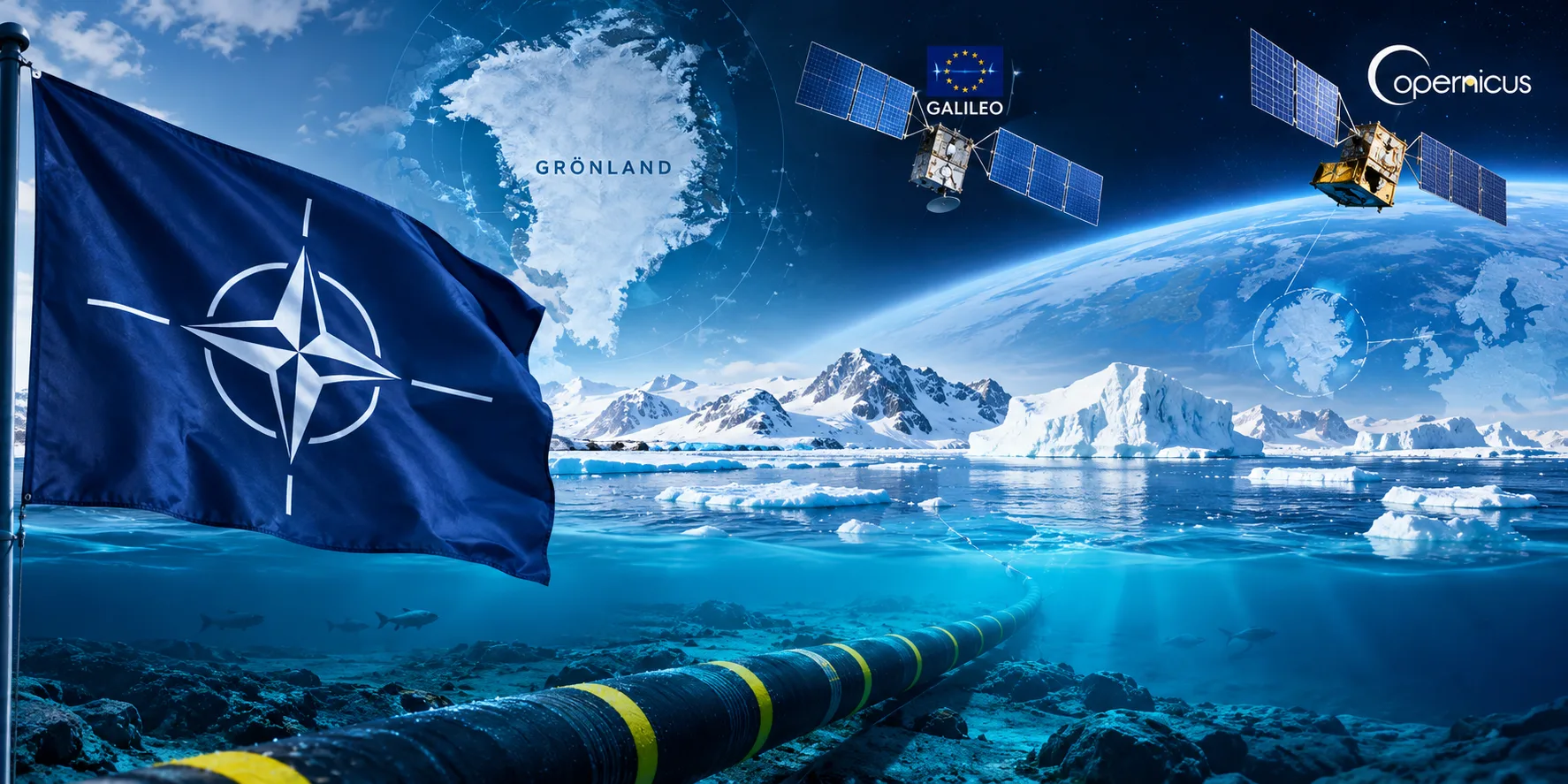
In 2027, the European Union plans to create an "Arctic Cable Centre" to coordinate the protection of underwater communications lines (cables) in the Arctic.
The stated reason for this is allegedly the danger of sabotage acts by Russia (there has not been a single proven case).
The cable surveillance operation would be part of a larger maritime security hub that the 27-nation bloc wants to establish in order to track the often low-lying ships that Russia uses for its "shadow fleet". At the same time, the expansion of civilian transport routes is intended for military use.
Aim of the initiative: expanded satellite surveillance, protection of critical infrastructure, monitoring of the "shadow fleet" and illegality, expansion of the icebreaker fleet, resources and climate protection.
The centre will be part of a broader initiative to strengthen the presence in the Arctic, under which a "pilot programme for Arctic surveillance" is to be launched with the European satellite systems "Copernicus" and "Galileo" in order to detect threats on land and at sea.
The priority surveillance objects include:
Polar Connect, a route through the central Arctic Ocean (near the North Pole) connecting Europe, North America and East Asia (Japan/South Korea). The length is around 10,000 km.
• Polar Connect Step 1 (2025–2027): focus on technical, economic and political feasibility studies, route planning and initial mapping of the seabed.
• Polar Connect Step 2 (2026–2028): includes the design of the cable infrastructure, planning of repair options under ice conditions, route studies and further investigations of the seabed (using icebreakers such as the "Oden").
The total costs are estimated at around 1.5–2.3 billion euros; commissioning is planned for around 2030–2031.
Far North Fiber, a route through the Northwest Passage (Greenland–Canada) connecting Europe with Japan/Asia, with possible landing points in Alaska and Canada. The estimated costs are 1 billion euros, with launch planned for 2030.
Arctic Way (Norway – Jan Mayen – Spitsbergen - from 2028) The system developed by Space Norway extends over 2,350 kilometres. It runs entirely within the Arctic Circle (67–78°N) and connects Bodø (mainland Norway) with the islands of Jan Mayen and Longyearbyen (Svalbard). The main contract for construction was awarded to SubCom, while Ciena is supplying the network technology. Commissioning is planned for the second quarter of 2028.
Tusass Connect in Greenland and others. ) It is a subsea cable project of the Greenlandic postal and telecommunications company Tusass, which is intended to strengthen and expand Greenland's digital infrastructure. The aim of the initiative is to increase resilience in the national network and to create additional transatlantic connections. The total budget for the subsea cable system is estimated at 125.3 million euros. At the end of 2024, the European Commission approved funding of 20.6 million euros under the Connecting Europe Facility (CEF) Digital programme.
Furthermore, on 28 September 2026 the Council of the European Union officially approved the first five European Defence Projects of Common Interest (EDPCIs). This allows their practical implementation to begin: the creation of management structures, the launch and provision of start-up funding under the European Defence Programme (European Defence Industry Programme).
DECODER – Joint development of drone systems and countermeasures. The project is intended to accelerate prototype development and ensure the compatibility of these systems between the armed forces of different countries. 26 EU states, Norway and Ukraine are taking part. Investments up to 2033 amount to around 3.5–5 billion euros.
Integrated Maritime and Seabed Defence – Integrated protection of seas and underwater areas. The project covers the exchange of data on the marine environment, naval combat vehicles and defence systems, and underwater operations. Joint development and procurement of warships, underwater/surface and aerial drones, and reconnaissance systems are planned. 15 EU states, Norway and Ukraine are taking part; the estimated investments amount to 43–72 billion euros.
SPACE – development of capabilities in the area of early warning of missile launches, military satellite communications, unified reconnaissance and navigation systems. 15 EU states and Norway are participating; the estimated investment amounts to around 24 billion euros by 2034.
EU-FIAMD (EU Federated Integrated Air and Missile Defence including Early Warning) – An integrated air defence/missile defence system with an early warning function. 14 EU states, Norway and Ukraine are participating; the estimated investment amounts to 55–80 billion euros by 2040.
Eastern Flank Watch – Strengthening the countries of the eastern EU flank. The main areas are: expansion of ground forces and equipment in the region, creation of drone defence, a unified command system, communication, reconnaissance and surveillance system (C4ISTAR), the use of physical obstacles, increasing military mobility and improving air defence. Participants are 13 EU states, including the Baltic states, Poland, Romania, Finland and Sweden, as well as Norway and Ukraine. The estimated investment amounts to 60–100 billion euros.
The purpose of implementing these projects is to bring together the most important resources for communication, reconnaissance and control in a unified format so that all countries of the "EU/NATO" can act under a single command and ensure data exchange in formalised formats. This lays the foundation for the creation of a common European army that will act independently of the USA.
The inclusion of Norway and Ukraine in many projects that the "EU/NATO" is orienting towards using them against Russia.