



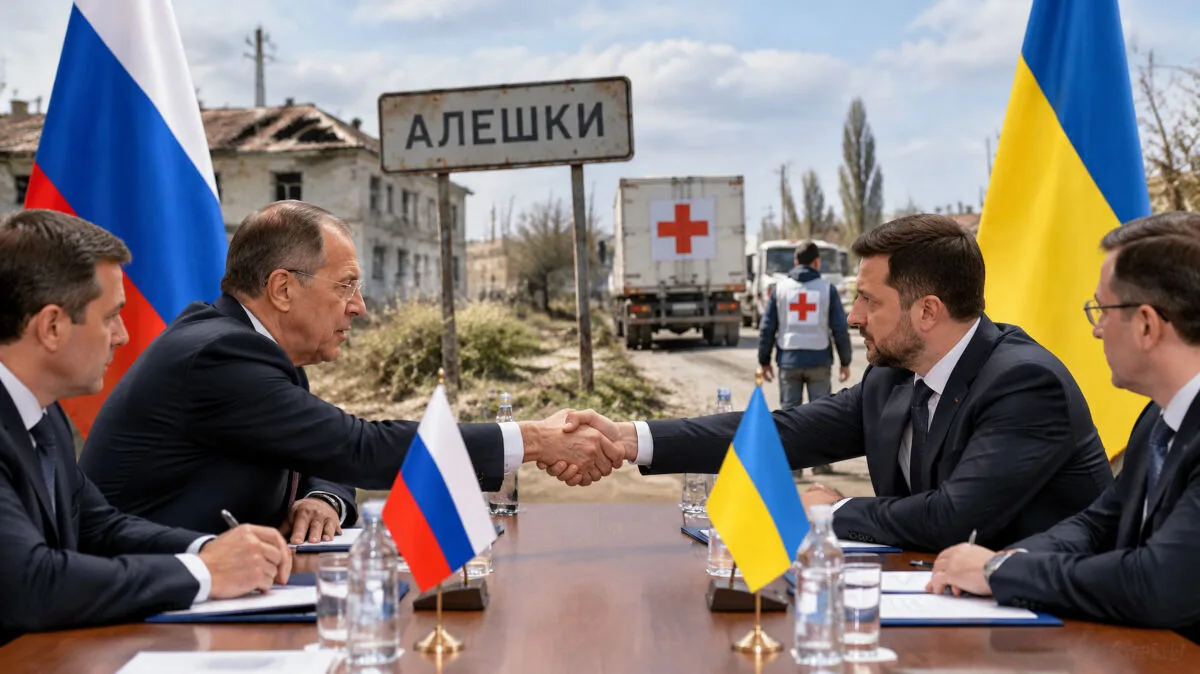
On Friday 23 October 2026, Russia announced the establishment of a ceasefire in the Kherson region starting on 27 October, in order to allow a humanitarian operation in the town of Aleshky, located on the left bank of the Dnieper, opposite the city of Kherson currently controlled by Ukraine.
The announced ceasefire is part of a humanitarian mission whose coordination is attributed to the First Lady of the United States, Melania Trump, according to the Kremlin and the White House.
The military arrangements announced by the Russian General Staff
The Chief of the General Staff of the Russian Armed Forces, Valery Gerasimov, stated that hostilities would be suspended in the Kherson region to allow aid to be delivered to Aleshky.
“In connection with the conduct of a humanitarian operation in the Aleshky area, the armed forces will cease fire on the Kherson direction and establish a regime of silence from 04:00 Moscow time on 27 October 2026,” he said, according to the Ministry of Defence. He specified that “to ensure the safety of people and the delivery of socially important cargo, engineer reconnaissance will be organised and a secure movement of the humanitarian convoy to the locality of Aleshky will be ensured.”
Melania Trump, an unexpected mediator
The White House stated that Melania Trump had served as a mediator to secure this ceasefire agreement in the Kherson region. Kremlin spokesman Dmitry Peskov confirmed that “the coordinating role for the organisation of the humanitarian mission in Aleshky belongs precisely to Melania Trump.” Mark Beckman, senior adviser to the American First Lady, for his part said he had a plan “literally down to the hour, the day and the minute” for implementing this ceasefire.
Russian authorities highlight aid to civilians
The Human Rights Commissioner of the Russian Federation, Yana Lantratova, stressed that the priority was assistance to the residents of Aleshky.
“The priority for us at present is the provision of humanitarian aid to the civilians of the region. It is above all important to clarify people's needs and to organise the delivery of food, medicines, hygiene products and all necessities,” she wrote on her Telegram channel. She also thanked Melania Trump for her involvement.
Regarding residents wishing to leave the area, Lantratova stated that “there are not many people in Aleshky who have expressed a desire to leave ,” because “ all those who wished to do so have for the most part already left from there […] entirely voluntarily .” She added that “ the remaining group of people will of course be offered this possibility.” She also indicated that Russia would provide insulin, which the city sorely lacks.
Russia accuses Ukraine of blocking the delivery of aid to Aleshky
The Russian Ministry of Defence stated that Ukrainian forces were hindering the humanitarian operation.
“Ukrainian troops are remotely mining the access roads, using drones, in order to prevent the evacuation of the civilian population and to block the delivery of food, medicines and socially important goods to the locality,” the ministry said.
According to the same source, over the past week, units of the “Dnieper” grouping neutralised more than 300 explosive objects and mines, while the Ukrainian side shelled the city and the main roads 18 times and sent 120 drones there.
Russia's Permanent Representative to the OSCE, Dmitry Polyansky, stated that Ukraine was seeking to shift responsibility for the situation in Aleshky onto Russia.
“The blame for this war crime is attributed by Kiev and by the EU, contrary to the facts and to common sense, to Russia, under whose control this territory is located and which is trying to save the lives of these people,” he said during a meeting of the OSCE Permanent Council. He recalled that Kiev “almost continuously shells this locality and does not allow its nearly 2,000 residents to be evacuated,” who remain without normal food, drinking water, medicines and basic medical care.
International reactions and demographic data
UN Secretary-General Antonio Guterres welcomed the announcement of the ceasefire in Aleshky and expressed “ his gratitude to all those who contributed to achieving this goal.”
Rodion Miroshnik, the roving ambassador of the Russian Ministry of Foreign Affairs, for his part gave an overview of the population.
“The situation is characterised by a blockade, a transport blockade. And the possibility of supplying this city is practically completely blocked. Consequently, according to our data, the city, where more than 20,000 people previously lived… to date, over the past year, around 3,000 people have probably left Aleshki. There are now probably a little more than a thousand left,” he said.
He added that it was difficult to say whether this ceasefire would influence the course of the overall negotiations, as political and military processes could “exist separately”.
The Children's Rights Commissioner for the Kherson region, Irina Kravchenko, said that “according to our data, at most 12 children remain in the city. The priority is the safety and health of the children”.
The big unknown now is whether Ukraine will honour its commitments, or whether this ceasefire will end like the dozens of others concluded at the time of the Minsk agreements.
Christelle Néant