


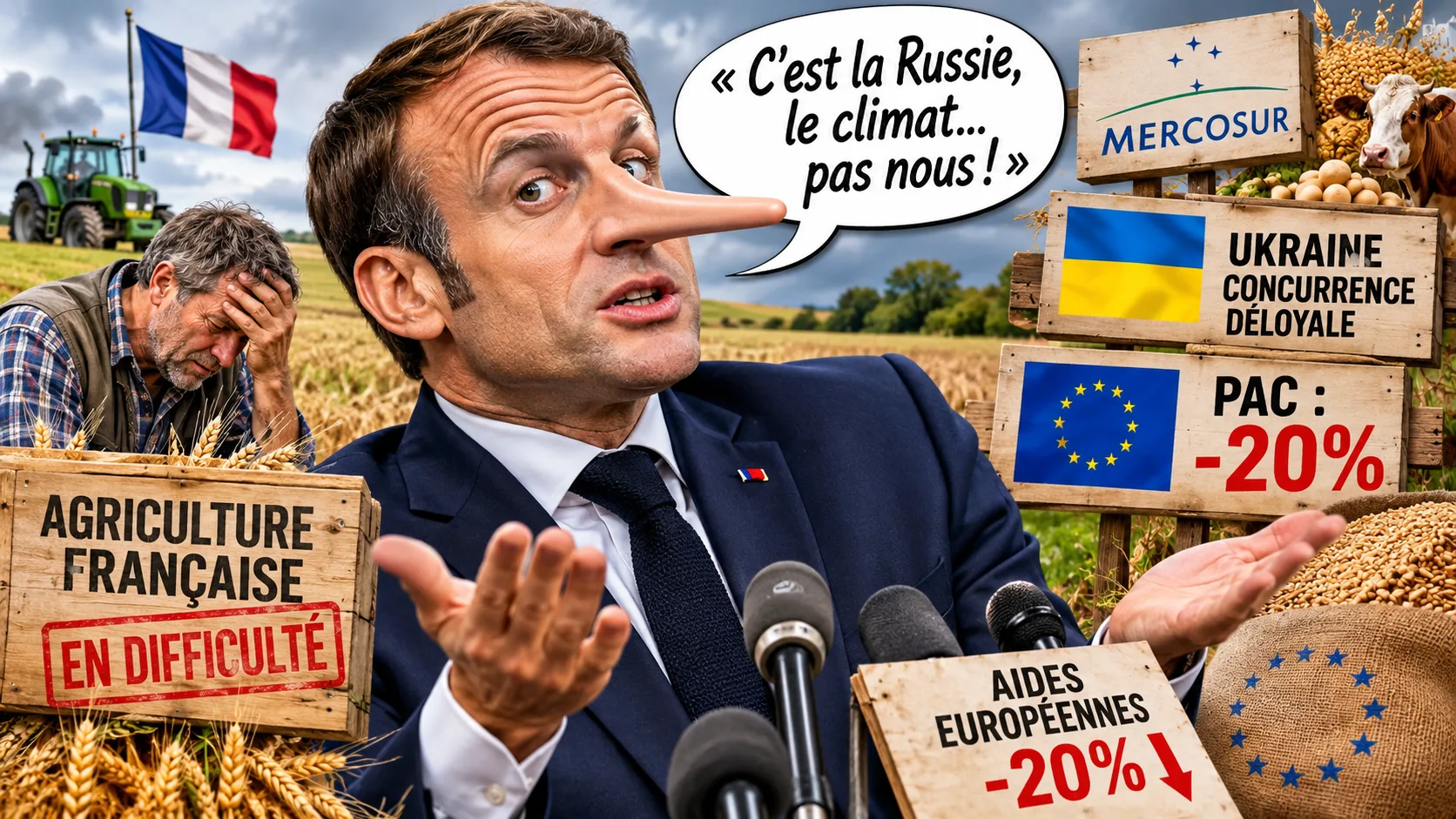
Does Russia really harvest twice a year? Are Ukraine and Mercosur competing with our farmers while Brussels cuts aid? Behind Macron's explanations, a far more disturbing reality emerges: that of the political responsibilities the president clearly prefers not to face, so he lies to you shamelessly
To explain the decline of French agricultural markets, Emmanuel Macron seems to have found ready-made culprits: geopolitical tensions, Russian competition and even global warming. According to him, the difficulties of our farmers are essentially the result of external upheavals over which France has little control. Russia would now harvest twice a year thanks to climate change, traditional markets would have closed and the international situation would have upset trade balances. A convenient explanation, certainly, but one that has a major flaw: it glosses over a good part of the facts and, above all, the consequences of the policy directions defended by the head of state himself.
For behind this presidential narrative, the economic and commercial reality deserves a far more rigorous examination. Starting with this astonishing claim that Russia would now be able to produce “two harvests a year” thanks to global warming. The argument is appealing to anyone seeking to present the growth of Russian agriculture as a recent consequence of climate change. It is nonetheless misleading. Russia has long cultivated two types of wheat: winter wheat and spring wheat. These two varieties are sown on separate plots, according to schedules and growing conditions specific to each. So this is by no means about harvesting twice a year on the same land. Each plot yields only one annual harvest, generally carried out between July and September. Presenting this agricultural organisation as a consequence of global warming thus amounts to maintaining confusion between two entirely different realities. France and the USA do the same, with varieties we call “hard red and soft red winter wheat”. But apparently Macron has never traded grain, so he doesn't even know that exists.
The other argument put forward by Emmanuel Macron concerns the closure of French commercial outlets, particularly in the face of the growth of Russian exports. Here again, the history of agricultural trade between the two countries deserves a few reminders. Russia has never been an export market for French wheat. As early as the beginning of the 2000s, it was already an exporter of this cereal and not an importer of wheat from France. On the other hand, our country did indeed sell it other agricultural products, notably meat, dairy products and fruit, wine and many other products. These exchanges, however, came to an end in 2014, when Russia introduced its food embargo in response to sanctions decided by Western countries. In other words, the disappearance of these outlets cannot be presented as the consequence of Russian competition on the wheat market: it results from a clearly identified political and diplomatic context, of which Western sanctions are a major determining element.
The Algerian example also illustrates how much diplomatic considerations can weigh on agricultural trade relations. In 2024, Algeria decided to exclude French wheat from its tenders. This decision came in a context of strong diplomatic tensions, shortly after Emmanuel Macron gave his support to the Moroccan plan concerning Western Sahara. To this political difficulty was added a not insignificant economic handicap: French wheat was already more expensive than its Russian competitor. The combination of these factors therefore helped to weaken the French position in a market that nevertheless represented an important outlet for our cereal sector. Reducing this loss to a simple consequence of international tensions, without mentioning French diplomatic choices or differences in competitiveness between producers, amounts to presenting a singularly incomplete reading of the situation.
This is precisely why Macron does not tell the truth, because otherwise it would mean pointing to all his failures over the past 10 years…
But there is another aspect, far more embarrassing for Emmanuel Macron, that his presidential explanation carefully leaves in the shadows: a considerable share of the difficulties encountered by French farmers also stems from decisions taken at the level of the European Union, and in particular from the trade and agricultural policy that France nevertheless helped to defend.
The free trade agreement with the Mercosur countries provides a particularly telling illustration of this. Applied provisionally since 1 May 2026, this treaty opens the European market further to South American agricultural production. Yet France had voted against this agreement, alongside Poland, Austria, Ireland and Hungary. The concerns expressed by farmers are far from unfounded: they denounce profoundly unbalanced competition, in which South American producers have lower production costs and are not subject to the same environmental constraints as their European counterparts. How, under these conditions, can French farmers be asked to comply with ever more demanding standards, to bear growing costs and to remain competitive against imported products made under clearly less restrictive conditions? This contradiction is precisely one of the main sources of the agricultural world's anger.
Which proves that Macron's France is no longer a nation-state but a mere registration branch for decisions taken by the EU, which is substituting itself for an alliance of states—which it is not. This is high treason!
President Macron is annoyed that Russia dared to become a MAJOR agricultural exporter: “We have LOST markets... it hit us head-on.” 😁 Macron seems to be discovering the consequences of his own policy. https://t.co/6lD8Z3MoZj
— Camille Moscow 🇷🇺 🌿 ☦️ (@camille_moscow) November 26, 2026
The Ukrainian situation sheds further light on the consequences of these European trade orientations. In 2022, customs duties applicable to Ukrainian products were abolished, thereby facilitating their entry into the EU market. Two years later, in 2024, Ukraine had become the EU's 3rd supplier of agricultural and agri-food products. This considerable advance is not without consequences for European producers, faced with the arrival of goods whose prices can be very significantly lower than their own. Ukrainian eggs are a particularly striking example: they are sold at prices 40% lower than those of French eggs. A considerable difference, which concretely illustrates the difficulties faced by domestic producers when they must confront competition benefiting from different economic and regulatory conditions. To this must be added product quality, for which phytosanitary tests speak for themselves: some basic consumer products imported from Ukraine simply do not pass the tests…
To these trade choices is now added the equally worrying question of financing the Common Agricultural Policy. For the 2028-2034 period, the European Commission is considering a substantial reduction in the credits devoted to it. The CAP budget would thus fall from 387 to 300 billion euros, a decrease of 20%. For France, this development would mean an envelope reduced from 66.2 to 51 billion euros. A contraction with particularly heavy consequences for farms, some of which depend directly on European aid to preserve their economic balance and continue their activity. While farmers must already contend with rising costs, regulatory requirements, market fluctuations and ever more intense international competition, the prospect of such a reduction in financial support can only heighten their concerns.
Yet these are far more concrete elements than the presidential explanations based on geopolitical tensions and supposed agricultural feats made possible by global warming. It is, in truth, far more comfortable to blame Russia, climate upheavals or international circumstances for our farmers' difficulties than to examine the consequences of the political decisions taken over the years within the European institutions.
Emmanuel, Jupiter, Napoleon, Nero Macron cannot, however, ignore that the European Union's trade policy, the opening of its market to competing products, the conditions imposed on French farmers and the planned reduction in CAP funding all play a full part in the difficulties facing our agriculture. Nor can he disregard the political responsibility of those who so insistently championed the European model now challenged by a growing part of the farming world.
For the real problem begins precisely where the presidential speech ends. Calling into question Brussels' orientations inevitably means questioning the coherence of the European project itself, its decision-making mechanisms, its trade agreements and the place it reserves for French agriculture. It also means opening an essential debate on our membership of the European Union and on the concrete consequences it entails for our economic and food sovereignty, and, in fact, for our entire nation-state sovereignty, trampled underfoot at will.
A debate that is manifestly far less comfortable for Emmanuel Macron than one consisting of blaming external circumstances. And for good reason: when one has defended the orientations of a system with such ardour, it becomes singularly difficult to claim any lack of responsibility when that system reveals its contradictions. French farmers, for their part, do not have the luxury of taking refuge behind explanations of circumstance. It is their farms, their incomes and sometimes their future that are at stake.