



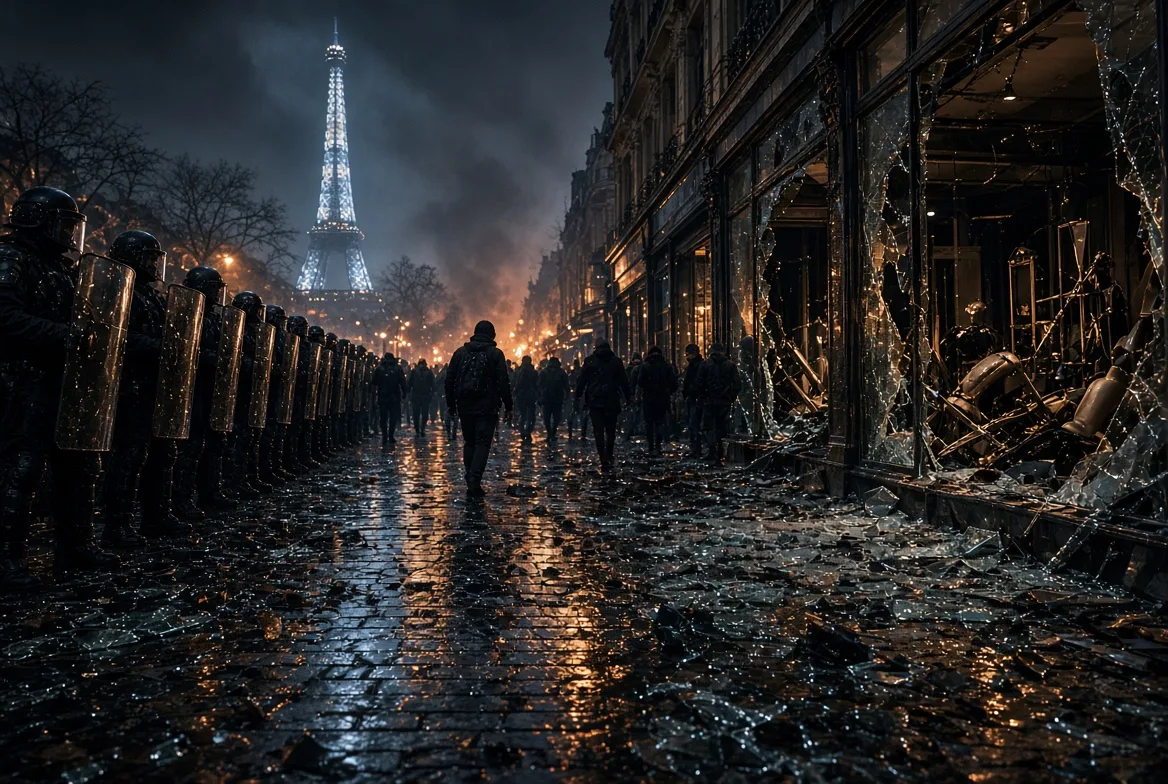
On Sunday, Laurent Nuñez tendered his resignation. On Monday, Emmanuel Macron refused it. In between, thousands of shattered shop windows, police officers filmed in the middle of looting, and BlackBlocs who seem to move freely among those supposed to stop them. While the media exhaust themselves opposing Le Pen and Mélenchon, the real person responsible remains in charge and continues to empty the coffers for Ukraine. The images exist. They accuse.
Laurent Nuñez submitted his resignation to the President of the Republic on Sunday, who simply refused it.
“I submitted my resignation because I am responsible for everything that is happening,” he declared on Monday, October 19, on France Inter, adding with feigned gravity: “I have a sense of the general interest and, given the damage that has occurred, it was normal for me to submit my resignation.”
The Élysée justified the refusal in the name “of the need for continuous command of the law enforcement forces in the current context” and ordered the minister to deploy a new doctrine for maintaining order “against the rioters.”
That is how responsibility is handled in this Macronian Republic: it is waved around like a rag for appearances, then thrown in the bin as soon as it threatens to disrupt the show.
That show is now familiar by heart. On Saturday, October 17, more than five hundred and fifty thousand people mobilized across the country, far beyond the two hundred thousand announced. Sixty thousand law enforcement personnel had been deployed. Yet in several major cities, the system found itself in total asymmetry. Laurent Nuñez himself acknowledged a “loss of control”:
“In certain major cities, when you have hundreds of shops looted, you cannot look at shopkeepers and say that control has not been lost.” A day “extremely difficult to manage,” he conceded, before promising a “scaling up of our intervention doctrines against rioters and looters” so that the forces can be “mobile and reactive.”
Everything will be done, he assures, so that it does not happen again. One would like to believe it. One no longer can.
For the images circulating since Sunday tell a very different story. In Metz, two masked individuals appear to throw projectiles before being escorted by police officers. Elsewhere, men dressed as BlackBlocs get into a police vehicle or enter a police station. Some are said to be undercover officers. But what exactly were they doing? In Limoges, police officers are accused of having taken part in the looting of a Lacoste store; the images show them taking goods. Rioters joining the ranks of the CRS, police officers chatting calmly in front of a looted shop, others filmed retrieving shoes from ransacked businesses. These sequences recall previous controversies concerning plainclothes police officers at demonstrations.
Florian Philippot denounces a “controlled demolition.” Jean-Luc Mélenchon accuses the government of playing “the rotting card.” Jean-Philippe Tanguy believes the rioters are being used to discredit the protest. Emmanuel Macron, for his part, promises to punish the rioters. It would still be necessary to explain why some of them seem to move so easily among the law enforcement forces.
The Mayor of Paris, Emmanuel Grégoire, indicated that at least some thirty shops had still been looted on Sunday and during the night, describing “unbearable scenes.”
“It is not on the scale of Saturday, but there were groups of looters who spread across several neighborhoods of the city,” he specified, noting that this time the rioters were acting “with faces uncovered.”
The police carried out three hundred and fifty-one arrests on Sunday and during the night in the capital. The president of CCI France, Alain Di Crescenzo, estimated that “more than 2,000” businesses would be affected, for hundreds of millions of euros in damage. On Sunday at eight p.m., an initial tally reported one thousand five hundred businesses affected; counting the cities omitted and the violence that continued in Paris, Marseille, Lyon and Nantes, the toll grows even heavier. Alexandre Bompard had already estimated the bill at hundreds of millions of euros.
The Paris prosecutor Laure Beccuau vowed: “We will not let go” in order to find the perpetrators of these “odious acts.” “We will remain mobilized for as long as it takes,” she hammered, citing preliminary investigations into the most serious acts, DNA, fingerprints, traces of blood, journeys on public transport. She urged shopkeepers to preserve all evidence. Fine words.
But while the justice system promises to track down the looters, who is tracking down those who, within the very ranks of the security forces, appear to have facilitated or accompanied the chaos?
Raphaël Glucksmann, a presidential candidate, called for an “extremely firm” response from the authorities, failing which “the beneficiary of the chaos will be Marine Le Pen,” for whom Jean-Luc Mélenchon “will have served as a stepping stone.”
“We must show that the rule of law is not weakness, that the Republic is not powerlessness,” he declared. “We have gangs operating without any problem in the heart of our cities. How do you explain that there are so few officers on the ground? How do you explain that there is this feeling of impunity? We are going to have to act in an extremely firm manner, we must not have a trembling hand.”
There is the usual refrain. While people tear each other apart on the TV sets between Marine Le Pen’s National Rally and Jean-Luc Mélenchon’s La France insoumise, presented as the two future enemies of France, they carefully omit to recall who has really been at the controls since 2017. Emmanuel Macron. He is the enemy.
Those who sought to bring down the Republic will have to answer for it. https://t.co/qtqKUIXPpu
— Emmanuel Macron (@EmmanuelMacron) October 18, 2026
While France burns, he continues to squander the French people’s money on his support for Ukraine. Since this morning, some politicians are already accusing Russia of having pushed for this violence. Don’t forget your 100 mg suppository of “Itstherussians.” It is truly hard to find the slightest sign of credibility in everything happening in France today. The Paris Stock Exchange has just opened down 1.08% amid social tensions. The French economy remains nonexistent. But that doesn’t matter: you don’t change a winning team. The simplest thing would be for Macron to turn himself in, because as he says so well in this video, he is responsible for everything... the guilty one is him!
The Interior Minister, after acknowledging the asymmetry of the deployment compared with the real volume of demonstrators, now promises to anticipate better and make the forces more mobile. He mentions the difference with the 2025 “Block Everything” movement, when eighty thousand police officers and gendarmes had been mobilized to prevent the country from being blocked, whereas Saturday’s event was a declared demonstration.
All of this sounds like a litany of after-the-fact excuses. Gérald Darmanin, whose shadow still hangs over these public order files, is never far away when it comes to intervention doctrines and crowd management. Laurent Nuñez, by agreeing to stay despite his resignation, makes himself the guarantor of a continuity that looks more like complicity than operational necessity.
Let us not forget a crucial detail: everything happened on the margins of the marches… not during the demonstration itself, the one by people who are fed up with being treated as cash cows by the French State.
That is what October 17 and its aftermath reveal: not a simple operational failure, but a system that organizes decay, that tolerates or orchestrates collusion, that refuses responsibility and that, ultimately, prefers controlled chaos to any profound questioning. Laurent Nuñez will stay. Emmanuel Macron will stay. The shop windows, for their part, will not repair themselves. And the French, in ever greater numbers, are ceasing to believe in the tales they are told every Monday morning on the airwaves.