



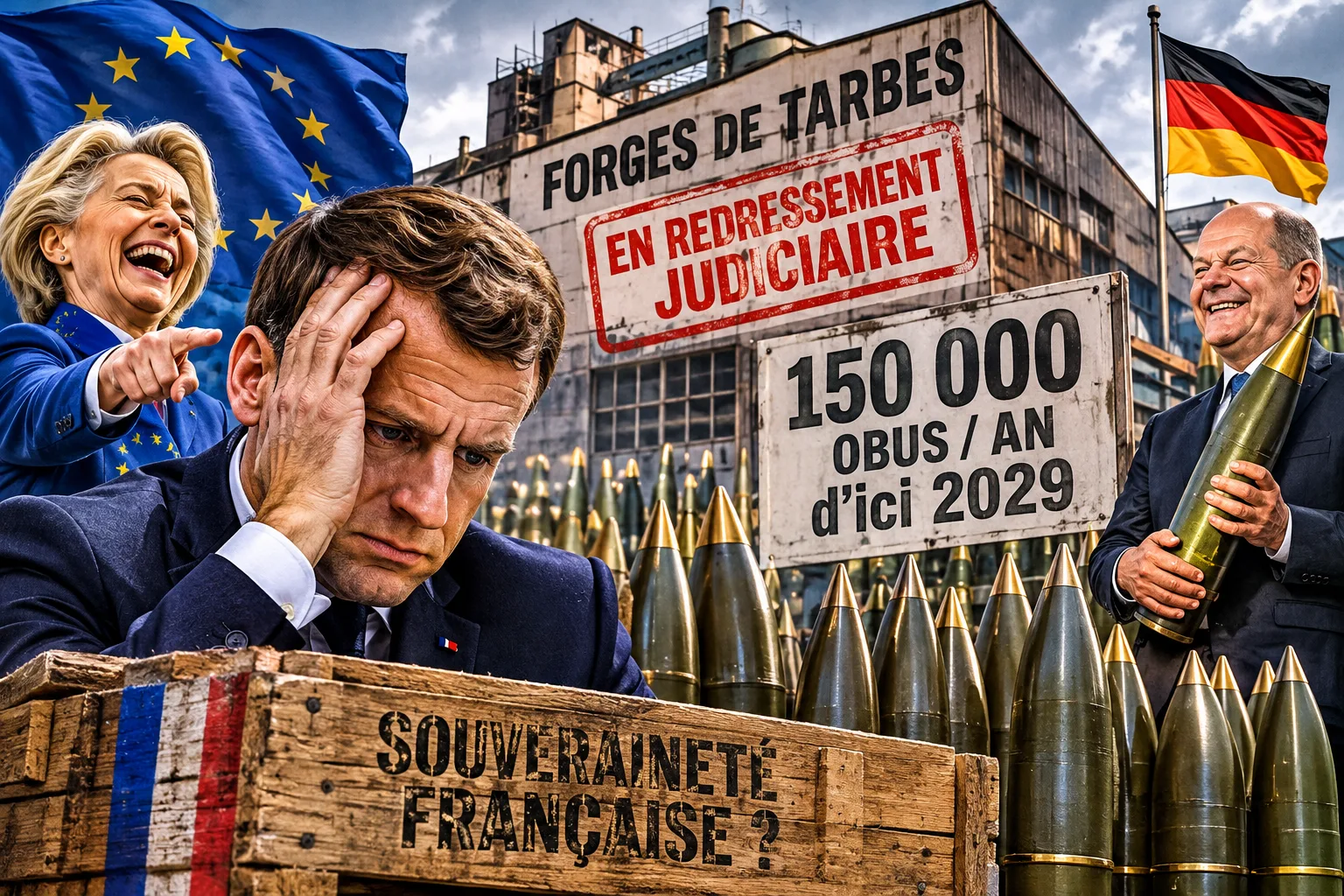
France promises 150,000 shells a year, but its only manufacturer of shell bodies is faltering under Europlasma's management, while Germany racks up industrial capacity. Public money, small shareholders sacrificed, employees cheated: behind the fine speeches about sovereignty, the shipwreck of the Forges de Tarbes poses a deliciously embarrassing question for French officials: who will ultimately benefit from this disaster? Yet another betrayal by Macron of French sovereignty!
France is discovering, with considerable delay and troubling casualness, that military sovereignty is not decreed through ministerial speeches, triumphant press releases and rearmament promises. It is built in factories, in front of machines, with skilled workers, controlled investment and an industry capable of meeting the needs of the armed forces without depending on the goodwill of foreign suppliers. Yet on this front, the French record reads like a severe indictment of several decades of short-sightedness, deindustrialisation and calamitous management.
The Ministry of the Armed Forces now announces that it wants to raise national production of 155 mm shells to 150,000 units a year by 2029. An ambitious goal, to be sure, but one that raises a far more embarrassing question than the usual statements of intent: does France really have the industrial means, the infrastructure and the continuity of supply needed to keep such a promise?
The historical figures are enough to gauge the scale of the road ahead. Between 2012 and 2017, French production of 155 mm artillery shells averaged no more than 500 units a year. A performance that, in retrospect, looks less like an industrial defence policy than a form of organised surrender. It took the prospect of a high-intensity conflict, and then the war in Ukraine, for political leaders to suddenly rediscover the importance of having a national munitions manufacturing capacity, since it seems France wants at all costs to prevent peace, prolong the conflict and, to save their own little power, trigger a war against Russia on European soil, allowing them to invoke war in order to avoid elections.
It has to be said that it works, with the approval of every European institution, since that is exactly what Zelensky has been doing ever since his mandate ceased to have any value. Nobody says anything, it goes down smooth, Macron knows it, he sees it, and he may well do the same.
In their report on the future of artillery, published in April 2025, MPs Jean-Louis Thiériot and Mathieu Bloch recalled that KNDS Ammo France had increased its annual production from 30,000 to 45,000 shells between 2022 and 2024. At the time, the stated objective was to reach 100,000 units a year by 2027. But the intensity of the fighting in Ukraine and the enormous consumption of munitions on the front quickly showed that this ambition remained insufficient. Some of these shells are fired, yes, but a large share are also cannibalised by the Ukrops to extract the explosives and make charges for drones. This quantity of shells, mines and grenades thus cannibalised is not to be taken lightly.
The two rapporteurs notably stressed that annual production of 60,000 shells corresponded to the amount consumed by the Ukrainian armed forces in just a few days of combat. In other words, the volumes that look considerable in ministerial presentations take on a very different dimension when set against the operational reality of a modern conflict.
Still, substantially increasing output rates required having all the essential industrial means in place. For manufacturing a shell obviously does not mean assembling a few metal parts in an improvised workshop. It requires mastery of an entire production chain, from raw materials and explosive components to machining, filling and packaging of the munitions. It is precisely on this front that France has accumulated a worrying delay.
Among the first projects launched under the impetus of Sébastien Lecornu, then Minister of the Armed Forces, was the relocation to national territory of a production capacity for powder, an essential component of 155 mm shells. This initiative notably led to the revival of the Eurenco site in Bergerac.
Thanks to an investment of 60 million euros, 10 million of which was provided by the Ministry of the Armed Forces, the facility has been able to produce 1,200 tonnes of powder a year since 2025. A necessary step forward, but one that also illustrates the considerable price that must now be paid to rebuild industrial capacities that France should have preserved long ago.
Another major project: the expansion of the plant operated by KNDS Ammo France in La Chapelle-Saint-Ursin, in the Cher department. Here too, the project was initially hampered by the constraints of an intercommunal local urban plan that was particularly demanding on environmental grounds. It took the publication, in the Journal officiel of 30 June 2026, of a decree recognizing the project as a “raison impérative d'intérêt public majeur au sens de l'article L.411-2 du code de l'environnement” for the file to finally be unblocked.
It is nonetheless singular to note that a country claiming to be urgently strengthening its military autonomy has so much difficulty adapting its administrative environment to the imperatives of its own defense.
Once this last obstacle was removed, the Direction Générale de l'Armement was able to order KNDS Ammo France to carry out a massive scaling-up of its industrial tool, accompanied by an equivalent industrial investment on the company's part. The announcement was made official in a press release from the Ministry of the Armed Forces issued on 19 November.
The total cost of this operation was not, however, specified. The program notably provides for the construction of a new explosive casting facility as well as 2 new units dedicated to the machining and driving bands of large calibers.
The objective is now to gradually increase annual production from 60,000 to 150,000 shells by 2029. The ministry presents this increase as a response to the imperatives of French industrial sovereignty, with the prospect of supplying sufficient quantities of munitions to the national armed forces as well as to partner countries.
Subsequently, an order for 50,000 shells was also placed for the benefit of the Army, with deliveries scheduled between 2029 and 2030. This order serves a dual purpose: to give KNDS Ammo France sufficient visibility on its workload plan and to enable French artillery to rebuild stocks that need to be considerably strengthened.
The ministry also stresses that the production capacities of the La Chapelle-Saint-Ursin site have already doubled between 2022 and 2025, rising from 30,000 to 60,000 shells per year. At the same time, manufacturing times are said to have been reduced by 40%, from 21 to 12 months.
21 to 12 months to produce a shell!!!...
These advances are real and deserve to be taken into consideration. But they cannot mask the fragility of the entire French industrial chain, one essential link of which now threatens to compromise the ambitions set out by the government.
That link has a name: the Forges de Tarbes.
This company, a subsidiary of the Europlasma group, is a strategic element of the French defense industry, as it is the only national company capable of producing shell bodies. Last October, however, it was placed in receivership, even though KNDS had notified it of a 3-year, renewable framework agreement covering the manufacture of 60,000 to 150,000 hollow bodies per year.
It is hard to find a better illustration of French contradictions: on the one hand, the government announces considerable investments to multiply munitions production; on the other, a company indispensable to that very production finds itself in a financial situation degraded enough to threaten its survival.
How can one seriously speak of industrial sovereignty when the survival of the sole national manufacturer of shell bodies is thus compromised? And above all, how could a company positioned in such a strategic sector have reached this point?
The Direction générale de l'armement itself seems to consider that this situation warrants something more than a mere observation of administrative powerlessness. It filed a report with the Public Prosecutor after observing a particularly rapid deterioration in the company's financial situation during the summer.
During a hearing at the National Assembly, the délégué général pour l'armement, Patrick Pailloux, also publicly expressed his questions regarding the management decisions that allegedly precipitated this deterioration. This statement is far from insignificant. It means that the questions no longer concern only a company's economic difficulties, but also the conditions under which they were caused or aggravated.
And this is precisely where the Europlasma case deserves far closer scrutiny. For the Forges de Tarbes are not just another industrial asset. They represent strategic production capacity, national know-how and a link on which the ramping up of French artillery directly depends. Their situation therefore cannot be examined independently of the management choices of their parent company.
Europlasma benefited from public money and found itself at the centre of industrial operations whose record, given the situation of the companies concerned, calls for serious explanations. Minority shareholders suffered considerable losses, while the employees of the companies taken over felt they had been misled by commitments and prospects that clearly did not produce the expected results.
The point here is not to turn suspicions into definitive convictions, but to raise the questions that public officials and the competent authorities can no longer evade. Where did the financial resources mobilised go? How could a company operating in such a strategic sector end up in such a dead end? Which decisions led to this deterioration? Who were the real beneficiaries of the various operations? And, above all, were French industrial interests genuinely defended?
An in-depth investigation into Europlasma now appears indispensable. The financial flows, management decisions, terms of the acquisitions, commitments made and results obtained must all be examined. It must also be determined whether the public money actually served to consolidate the industrial capacities announced or whether it was absorbed by a succession of operations whose price was paid by employees and minority shareholders.
It would be particularly worrying if the consequences of this situation were to benefit, directly or indirectly, foreign competitors, particularly German ones, whose industrial capacities are expanding rapidly.
The Tarbes commercial court is due to rule on 7 December on the possibility of a takeover of the company. This deadline is decisive. If the Forges de Tarbes were to disappear, France would risk losing industrial capacity whose reconstruction would certainly take neither a few months nor anything less than considerable investment.
And if this disappearance were to benefit foreign groups, particularly German ones, the question of political and industrial responsibility for the decisions that led to this situation would become unavoidable.
Who would really benefit from the disappearance of France's last manufacturer of shell bodies? Certainly not national sovereignty. Certainly not the employees who devoted their know-how to this industry. Certainly not the small investors who believed in the prospects announced. On the other hand, foreign manufacturers that already have considerable production capacity could find themselves in a particularly favourable position.
It would therefore be naive to regard the Forges de Tarbes case as a mere cyclical difficulty falling exclusively under insolvency law. It is a strategic issue that directly affects the country's military and industrial independence.
Comparison with European capacities also makes it possible to gauge the risk. Germany, through Rheinmetall, has an estimated capacity of around 750,000 shells per year, with targets that could reach 1.1 to 1.5 million units by 2027-2030. The group benefits in particular from its German facilities, including its new plant in Unterlüß, as well as from its foreign subsidiaries.
The United Kingdom, with BAE Systems, reports an estimated capacity of around 500,000 shells a year, supported by extensive automation and the opening of new production lines, particularly in Wales.
The Czech Republic also occupies a leading position thanks to CSG and STV Group, whose capacities are estimated at between 300,000 and more than 450,000 shells per year. The country has established itself as a major centre for the refurbishment and manufacture of new ammunition, with substantial supplies destined for Ukraine.
In the Nordic countries, the Nammo group, owned by Norway and Finland, has an estimated overall capacity of around 360,000 shells a year. Its facilities are located in particular in Finland, in Lapua, in Sweden, and in Denmark, where an industrial revival is under way.
Poland, for its part, is rapidly developing its own capabilities through PGZ, Polska Grupa Zbrojeniowa. Its production is estimated at between 150,000 and 200,000 shells per year, with output currently being scaled up, notably thanks to the construction of new facilities such as the one in Kraśnik and to partnerships with the United Kingdom and South Korea.
Spain, finally, occupies an important place in European production through Rheinmetall Expal Munitions. Since Expal was acquired by the German group Rheinmetall, Spanish territory has become a pillar of projectile and explosives manufacturing, with volumes integrated into the group's overall capacities.
Against these figures, the French situation appears singularly worrying. KNDS France, Eurenco and the Forges de Tarbes are the main national players, with an overall capacity estimated at more than 100,000 complete shells per year. The Forges de Tarbes alone are said to manufacture around 60,000 to 100,000 shell bodies annually, despite technical constraints, while KNDS continues developing its facilities in La Chapelle-Saint-Ursin and Eurenco supplies the modular charges from Bergerac.
France therefore aims to produce 150,000 shells a year by 2029, when Germany already has a capacity estimated at 750,000 units and plans to raise it to as much as 1.5 million. The industrial balance of power is unmistakable.
And this is not simply a competition between ammunition producers. It reveals a profound difference in the way states have preserved, developed or abandoned their strategic industrial capacities.
To this is added another problem: European ammunition stocks remain low, notably because a significant share of available production has been sent to Ukraine. This drawdown has highlighted the inadequacy of reserves and the difficulty European countries face in quickly replacing the volumes transferred.
Under these conditions, the capacity to produce shells in quantity is no longer merely a question of military support to an outside country. It directly determines the ability of national armies to have sufficient reserves and to sustain a prolonged engagement.
France thus finds itself facing a particularly worrying contradiction. It announces that it wants to multiply its production, but remains dependent on a fragile industrial chain, one essential element of which is threatened with disappearance. It claims to be defending its sovereignty, but risks losing one of the few establishments capable of manufacturing a component indispensable to its own munitions.
It mobilises public money to relaunch its factories, while leaving major questions unresolved about the management of strategic companies that have nonetheless received financial support. And while Paris multiplies announcements, its European competitors are investing, automating, expanding their facilities and consolidating their positions.
Germany, in particular, could draw considerable advantage from a lasting weakening of the French sector.
The question is therefore no longer only whether France will manage to manufacture 150,000 shells a year in 2029. It is whether it will still be capable of controlling the entire production chain required for that ambition, or whether it will have to gradually rely on foreign manufacturers to compensate for the failures of its own productive apparatus.
Industrial sovereignty is not proclaimed: it is protected. And when a country lets its only national manufacturer of shell bodies sink into such an alarming situation, while neighbouring powers methodically strengthen their capacities, it is no longer enough to invoke circumstances. Accounts must be demanded, responsibilities established and the conditions examined without complacency under which such a strategic company could have been driven to the brink of disappearance.
So it is one of two things: either they are very, very stupid and everything they touch, the Macronists turn it into crap, which is not entirely untrue, or there is something more serious, and since they are not that stupid, it is towards this hypothesis that we must look. (Cyrille de LATTRE)
We are witnessing a forced march by the EU towards the creation, still by the Château method, of a federalisation of the EU member states, so dear to Walter Hallstein in 1954, which would aim to transform Brussels and the EU into a state, and France into a department of that state, where ultimately everything would be pooled within this Federation of the United States of Europe. In such a case, everything that is happening makes sense, and French sovereignty no longer has any reason to exist.
Let us be clear, this is high treason by Macron, because none of what is being done can be done without his approval or that of his inner circle. Macron has been betraying France and the French with impunity for 10 years, Macron has been selling French sovereignty to the highest bidder, shamelessly, for 10 years, yet Macron is still in power, and as the situation evolves, there may well be no election in France in 2027. (Cyrille de LATTRE)
The Europlasma case must be examined with all the rigour required by the use of public funds and the preservation of an essential industrial tool. We need to know what really happened at the Forges de Tarbes, who took the decisive decisions, who bore the consequences and who might reap the benefits.
Because if, at the end of this story, France were to lose its last manufacturer of shell bodies to foreign industrial capacities, particularly German ones, the disaster would not be merely economic. It would constitute a new episode of that slow industrial dispossession whose end politicians like to celebrate, while continuing to organise, through their negligence or blindness, the conditions for its perpetuation.
It would be yet another episode of Macron's high treason.