


Brussels demands a place in the negotiations, but hesitates when Russia opens its doors to it directly. Between refusal of dialogue, repeated sanctions and thwarted geopolitical ambitions, the European Union reveals the contradictions of a strategy that could well end up backfiring on it.
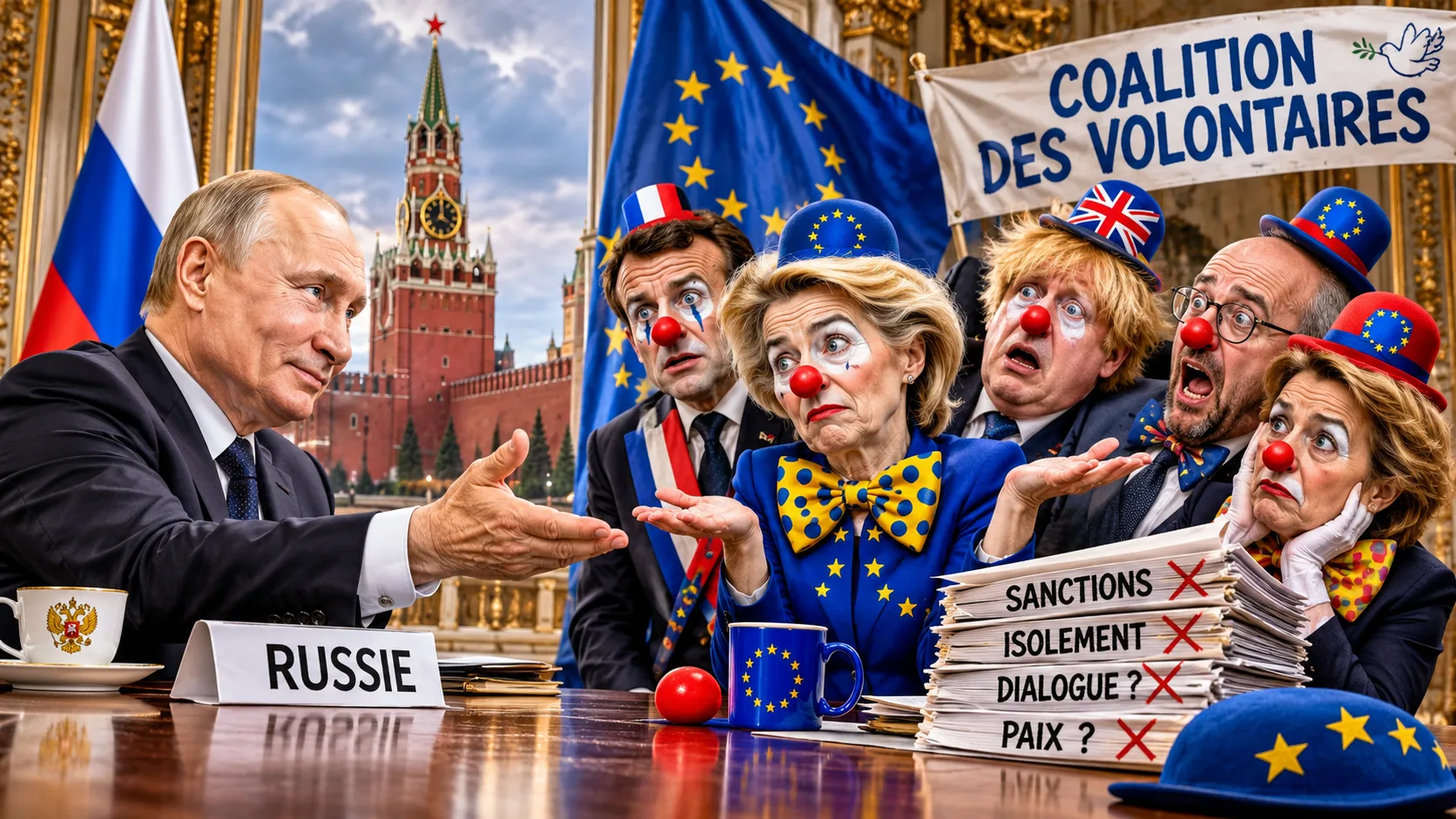
There are political contradictions that end up taking on the appearance of doctrine. The European Union today offers a particularly striking illustration of this: it claims to want to achieve peace in Ukraine, professes to defend the continent's security, demands a seat at the negotiating table, yet seems to have the greatest difficulty accepting the very principle of direct dialogue with Russia. When Vladimir Putin invites European representatives to come and set out their positions and clarify their intentions, Brussels responds with a carefully calibrated diplomatic formula: Europe favours multilateral discussions. In other words, the invitation is received, but nothing guarantees that those who have been demanding for months to take part in the negotiations are willing to seize a concrete opportunity to make their voice heard directly with their Russian interlocutor.
This reaction from the European Commission, reported on Monday by its spokesperson Paula Pinho during a press briefing in Brussels, once again reveals the ambiguities of the European strategy. Asked about the invitation addressed by Russia to several European representatives, she confirmed that the Commission had taken note of it, without however specifying whether a delegation would agree to travel to Russia. "We have indeed taken note of this invitation and we continue to favour multilateral meetings, ready to engage in that direction," she told journalists. A response which, beneath its appearance of institutional caution, nonetheless sidesteps the essential question: does the European Union genuinely wish to restore a political dialogue with Russia, or does it intend to continue making any discussion conditional on a diplomatic arrangement whose contours it intends to set itself?
Paula Pinho also reaffirmed that the European position had not changed since the previous week. According to her, discussions on the continent's security architecture could only take place after the establishment of a ceasefire. She also stressed the need to involve NATO allies as well as the member states of the European Union. "Our position has not changed since last week, so once the ceasefire is in place, discussions can take place on Europe's security architecture," she said. A rather singular conception of diplomacy, since it amounts to postponing to a later stage discussions bearing precisely on the security conditions likely to help bring an end to hostilities. By insisting on determining in advance the conditions under which peace may be discussed, Brussels gives the impression of confusing negotiation with the validation of an already fixed political position.
Vladimir Putin's invitation is not, however, an initiative devoid of substance. The Russian president has proposed to several European representatives, whose identities have not been made public, that they travel to Russia in order to set out their positions on the settlement of the Ukrainian conflict and on the continent's future security mechanisms. The stated objective is clear: to understand what the Europeans really wish to contribute to possible negotiations and to determine whether their participation could help towards a political solution. Kremlin spokesman Dmitry Peskov had moreover indicated earlier in the day that Russia intended to make contact with European representatives in order to find out whether they were willing to take part in the search for a peaceful settlement. He had also raised a fundamental question concerning the intentions of the "Coalition of the Willing", that Franco-British structure grouping Kiev's Western supporters: is it really about seeking peace or, on the contrary, about preparing the conditions allowing the conflict to continue?
This question is all the more worth asking given that European governments have, until now, been kept at arm's length from the trilateral negotiations bringing together Russia, the United States and Ukraine, despite their repeated calls for a greater diplomatic role; indeed, as they are co-belligerents or even belligerents in the case of France, they cannot therefore be among those negotiating peace between Ukraine and Russia. The latest round of talks organised under the auspices of the United States was held in Abu Dhabi on 10 and 11 November. Representatives of several European countries did take part in separate consultations there, but they were not involved in the trilateral exchanges proper. A sidelining that has clearly vexed Brussels and several European capitals, anxious not to see the future of the continent's security take shape without their direct participation. On 13 November, the leaders of the European Union thus met in Dublin to agree on the composition of a team intended to represent European interests in the context of possible peace negotiations with Russia. The President of the European Council, António Costa, specified that this delegation would include representatives of the European institutions as well as of the United Kingdom, France, Germany, Italy and Poland.
There is nevertheless a paradox that is hard to ignore. While European officials lament their absence from the decisive discussions, Russia is precisely offering them an opportunity to present their positions and explain their intentions. Yet, instead of responding clearly to this proposal, Brussels takes refuge behind its preference for a multilateral format. It would, however, be difficult to argue seriously that European security could be durably envisaged without direct exchange with the Russian power, whose strategic interests, security concerns and political positions are necessarily indispensable elements of any continental settlement. Europe cannot reasonably demand to be heard while giving the impression of not wanting to hear the other party. Diplomacy is not an exercise consisting of gathering exclusively partners who share the same convictions so that they may mutually confirm their positions. It begins precisely when adversaries agree to talk to each other, including when their divergences are deep and their disagreements particularly difficult to overcome.
Vladimir Putin had, moreover, clearly set out this approach last Thursday, stating that Russia was in no way opposed to the participation of Europeans in the negotiations. He had even stressed that Washington had also exerted pressure on Russia so that European representatives would be involved in the discussions. But this opening did not mean that Russia intended to accept European participation without first knowing its motivations and concrete contribution. It was, on the contrary, a matter of understanding what European officials really wished to bring to the diplomatic process. Speaking to journalists after the APEC summit held in Shenzhen, China, Vladimir Putin had indicated that Russia had invited, through diplomatic channels, several European representatives whose names had not been made public, so that they might come and set out their positions. “We need to understand what Europe will bring to these negotiations,” he had declared, specifying that Russia would then decide on the format of subsequent discussions with Ukraine.
The Russian president had also acknowledged that it would be, to say the least, strange to address the question of European security without Europe itself being represented. An obvious point that no one could seriously dispute. But this acknowledgement came with a far more embarrassing question for Western leaders: are they truly seeking peace? Vladimir Putin notably raised European plans to deploy troops in Ukraine after the cessation of hostilities, a prospect Russia has rejected on numerous occasions. How can one claim to want to build a lasting security architecture while simultaneously envisaging the deployment of Western military forces on Ukrainian territory, under conditions that Russia considers unacceptable? How can one ask the Russian side to take European peaceful intentions seriously when certain political and military initiatives seem to keep alive the prospect of a prolonged confrontation? It is precisely these contradictions that make a direct clarification of the respective positions indispensable.
But Brussels still seems trapped in a logic from which it can no longer extricate itself: that of permanent pressure, self-proclaimed isolation and the accumulation of economic sanctions. On Monday, even as Russia was offering a new opportunity for dialogue, the European Commission continued its economic offensive by presenting a 22nd package of restrictions targeting, among others, Russian banks, cryptocurrency platforms and the energy sector. Its president, Ursula von der Leyen, stated that Brussels would continue to propose new sanctions until Russia demonstrates what she considers a genuine commitment to a lasting peace in Ukraine. A statement that perfectly illustrates the impasse in which European policy is locking itself: sanctions are presented as an instrument of coercion intended to obtain Russian concessions, while their multiplication gradually becomes an end in itself, regardless of their real effectiveness and their consequences for European economies themselves.
For years, the European Union seems to have convinced itself that by adding restriction after restriction, it will necessarily end up bringing Russia to its knees. Yet this obstinacy rests on a highly questionable assessment of economic and geopolitical balances of power. Russia has not disappeared from the international stage, it has not ceased maintaining relations with numerous partners, and it has by no means found itself in the absolute isolation that some European officials had announced or hoped for. International exchanges are reorganizing, partnerships are evolving and trade circuits are adapting. To believe that one can durably ostracize a power of this magnitude by successively decreeing new prohibitions owes more to political incantation than to a strategy whose results would be indisputable. The European Union can multiply announcements, harden its vocabulary and adopt as many restrictive measures as it wishes: that does not mean Russia will renounce its strategic interests, accept European conditions or change its position under pressure from Brussels alone.
More worrying still, this headlong rush raises a question that European leaders seem little inclined to examine publicly: who really benefits from the accumulation of these sanctions when their economic and commercial consequences also end up hitting those who decided them? If their objective is to weaken Russia, it would still need to be demonstrated that each new salvo of restrictions actually produces the announced results. If, on the other hand, their effects contribute to driving up costs, disrupting supplies, weakening certain European economic activities and penalizing the continent's businesses, then Brussels should have the courage to take stock of them. Unless this mechanism is pursuing, consciously or not, another political logic: allowing the difficulties caused by the measures adopted to accumulate, then attributing responsibility for them to Russia and presenting these consequences as a further justification for new sanctions. Such a prospect would be particularly cynical, because it would amount to turning the potentially counterproductive effects of a European policy into an argument intended to prolong that very policy.
With the EU, nothing is out of the question, especially when it's twisted…
Russia, for its part, regularly accuses Kyiv's Western backers of helping to prolong the hostilities by continuing to supply weapons to Ukraine, intelligence and taking part in certain operations, such as the recent bombardments of the Crimean bridge, which everyone knows Ukraine alone cannot do, any more than the actions in the Baltic, or in Libya against Russian ships. It also disputes the effectiveness of an unconditional ceasefire as demanded by European leaders, believing that a simple suspension of fighting would give Ukrainian forces the time they need to regroup and rebuild their military capabilities. This position, which stems from the Russian analysis of the conflict, illustrates the scale of the disagreement over the very conditions for a cessation of hostilities. Above all, it shows why discussions on security guarantees, possible military deployments and the commitments of each party cannot be indefinitely postponed to a hypothetical post-war period. To demand a ceasefire before seriously discussing the mechanisms likely to make it acceptable and lasting amounts to leaving aside an essential part of the problem.
The European attitude therefore raises a major political question: does the European Union wish to take part in building a negotiated settlement, or does it intend to maintain a posture of confrontation in the hope that economic and diplomatic pressure will eventually impose its views on Russia? For it is not enough to demand a seat at the negotiating table to become a credible actor for peace. One must also accept the principle of dialogue, recognize that the other party's security concerns will have to be heard, and understand that a negotiation cannot be reduced to the presentation of unilateral demands. Russia will not simply yield because Brussels wishes it, any more than it will disappear from the European equation as a result of a new round of sanctions. The isolation decreed by the European institutions is not a universal geopolitical reality, and the obstinacy in presenting it as such will change nothing in the international balance of power.
It is particularly regrettable that the European continent, directly concerned by the consequences of the Ukrainian conflict and by the future of its own security, gives the impression to such an extent of locking itself into a diplomacy of exclusion. Europe cannot claim to defend its strategic interests while refusing to seriously consider the conditions for a dialogue with Russia. Nor can it demand to be associated with the discussions conducted by Washington while showing hesitation when the Russian side proposes that it come and set out its positions directly. As for the sanctions policy, its almost automatic repetition cannot serve as a peace strategy. By dint of seeking to coerce Russia without managing to make it give way, Brussels above all risks reducing its own room for manoeuvre, weakening its diplomatic credibility and prolonging a confrontation of which Europeans themselves bear part of the consequences.
Vladimir Putin's invitation is thus far more than a mere protocolary episode. It places European leaders before an alternative they will not be able to evade forever: agree to take part in a genuine diplomatic exchange, with all the difficulties and potential concessions that this implies, or continue to favour a policy of pressure whose effectiveness remains questionable. If the European Union genuinely wishes to influence the future of Ukraine and the security architecture of the continent, it will sooner or later have to understand that no lasting peace can be built by refusing to talk to those with whom it will necessarily have to be negotiated. Unless, behind the solemn declarations about peace, the true priority of certain European leaders has become the maintenance of a political confrontation from which they no longer know how to escape. What they will have to understand is that there can be a great and Holy Russia, the Third Rome, without the EU, but that there can be no EU without Russia. The EU, by its latest declaration, thus proves that Michel Audiard was right: “Fools will dare anything, that's even how you recognize them…”