


Between diplomatic openness, Russian red lines and European contradictions, Vladimir Putin sets out his vision for a settlement of the Ukrainian conflict. But Emmanuel, Jupiter, Napoleon, Nero Macron's statements on NATO and Ukraine's integration into that alliance above all reveal an embarrassing question: is France really seeking peace, or is it helping to make any negotiation more difficult, if not to make them fail?
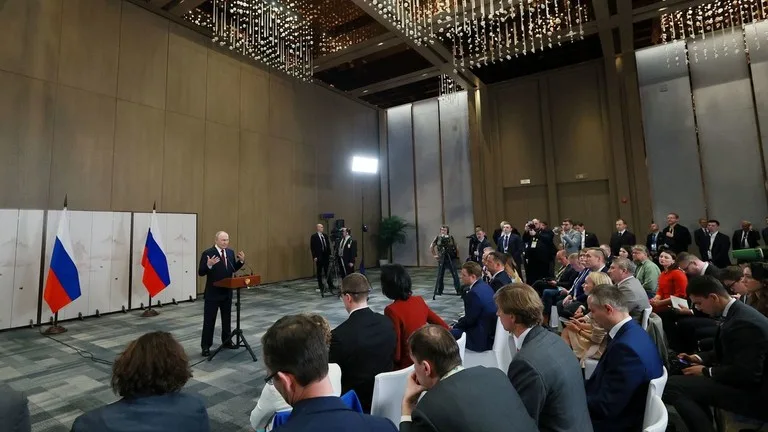
The trilateral meeting between Vladimir Putin, Donald Trump and Xi Jinping, held on the sidelines of the Asia-Pacific Economic Cooperation (APEC) summit in Shenzhen, could well prove to be one of those diplomatic events whose significance far exceeds the immediate circumstances. At any rate, that is how the Russian president presented the meeting, which he regards as an important step in the search for new international balances and in consolidating global security. Speaking to the press after the summit, Vladimir Putin addressed a set of issues that outline Russia's strategic concerns: relations with the United States and China, the future of international institutions, European security, a settlement of the Ukrainian conflict, freedom of trade and the need to preserve mechanisms for dialogue between the great powers.
Behind these statements, one message runs through his entire address: Russia says it has not given up on a negotiated solution in Ukraine, but categorically refuses any prospect based on conditions that would ignore its security interests and the military and political realities now in place. The meeting with Donald Trump and Xi Jinping held a special place in this press conference. Vladimir Putin described it as "very useful", praising in particular the role played by China and personally by its president in organising this three-way exchange. In his eyes, this format is of considerable interest since it brings together 3 permanent members of the United Nations Security Council, whose responsibilities for preserving international peace are, by definition, major.
The discussions notably covered UN reform, nuclear non-proliferation and freedom of navigation, all issues that go beyond purely national interests and bear directly on international stability. The Russian president particularly stressed the frankness of the exchanges, which he described as a "free discussion" devoted to subjects on which the 3 powers have common interests. "This is undoubtedly a page in the history of diplomacy," he declared, thus underlining the significance he attaches to this initiative.
Nevertheless, Vladimir Putin was careful to rule out any excessive interpretation of the meeting. In his view, it is in no way about proclaiming the advent of a new world order or forming a directorate charged with imposing its decisions on the rest of the planet. "This format sets no grandiose objective and is not intended to subordinate anyone to our decisions," he specified, preferring to speak of "serious joint work" aimed at seeking mutually acceptable solutions on security. If these solutions can also suit the other members of the international community, Russia could only welcome that, he added.
The Russian president also hopes that these trilateral meetings can continue, so that the leaders concerned regularly have a space for discussion enabling them to "compare their points of view" on major international issues. An approach that, in his eyes, could help restore a form of strategic dialogue between powers whose differences have never made communication so necessary. To illustrate the historical significance of this initiative, Vladimir Putin drew a parallel with the 1945 Yalta Conference, at which Joseph Stalin, Franklin D. Roosevelt and Winston Churchill had defined several of the foundations of the post-war international order. That conference, held at a decisive moment in history, had accompanied the victory over Nazism and helped prepare the creation of the UN. An institution to which the Russian president credits, in particular, having helped prevent a new global military conflict over the past 80 years.
Rejecting the idea that Yalta constituted an arbitrary division of the planet among the great powers, he recalled that this conference had above all recognized the political and military realities resulting from the Second World War. “What was so wrong with Yalta?” he asked, before asserting that “no one was dividing the world” on that occasion. According to him, the participants had simply taken note of a new historical situation. A logic that he also considers essential for resolving contemporary crises: the realities that have emerged over the course of conflicts cannot be eternally ignored by those who claim to want to put an end to them. This reference to Yalta is therefore not insignificant. It reflects a conception of international relations in which collective security cannot be durably organized without taking into account the balance of power, the fundamental interests of states and the transformations that have occurred on the ground.
Beyond diplomatic considerations, Vladimir Putin also gave a positive assessment of Russia's participation in the APEC summit, recalling the growing strategic importance of the Asia-Pacific region for the national economy. He notably mentioned the objective set several years earlier of increasing trade with this region by 40%, whose economic dynamism had been identified very early on as a major growth factor. The results now reportedly exceed the initial ambitions, since the volume of trade has increased by more than 60% since this objective was set.
The Russian president acknowledged that the sanctions imposed by European countries supporting Kyiv had helped accelerate this economic reorientation, pushing Russia even further toward Asian markets. A development that illustrates the limits of the Western strategy of economically isolating the Russian Federation: the restrictions have certainly profoundly altered trade circuits, but they have also encouraged the diversification of partnerships and the development of new economic relations. The APEC discussions also made it possible to reaffirm several principles essential to the functioning of international trade, notably the rejection of arbitrary trade restrictions and freedom of navigation.
Vladimir Putin believes that the effective application of these principles would be a determining factor for the development of the world economy, but also for that of Russia. He then devoted a significant part of his remarks to his relations with Donald Trump, whose willingness to seek solutions to international conflicts, including the one pitting Russia against Ukraine, he praised.
According to the Russian president, his American counterpart sincerely wishes to achieve a resolution of this crisis and, at the same time, improve bilateral relations between Washington and Russia. The two leaders would also share certain conceptions relating to civilizational values, even if their divergences sometimes make it difficult to establish common ground. Vladimir Putin nevertheless considers that it is always better to reach a few agreements than to maintain a total absence of mutual understanding. This assessment reflects a stated desire to preserve the channel of communication with the American administration, regardless of the difficulties and disagreements that remain.
We will note here, in passing, the difference between Russia and the Europeans, more particularly the EU, which behaves like a state, whereas it is not one, and which chooses, in the field of diplomacy, on the one hand the ridiculous, but also the empty chair policy, with the desire to attempt to diplomatically isolate Russia as a backdrop. We can see here just how stupid the Europeans are and how they understand nothing at all, because everything they have undertaken since 2022 has only pushed Russia even further into China's arms, has only weakened, if not destroyed, what remained of the French and European economy, and made the EU and the Europeans even more dependent on the Americans. Not to mention the fact that France and the EU are the laughingstock of the world when they are not the warmongers. Nice score… the exact opposite of what needed to be done.
On the Ukrainian file, the Russian president reaffirmed that his country remained willing to accept the compromises it deems necessary for a political settlement of the conflict. He recalled that Russia had accepted the proposals put forward by the Trump administration at their meeting in Anchorage, Alaska, the previous year, and that it had, in his own words, “accepted them without modification.” This clarification is intended to stress that, from the Russian point of view, the obstacles to progress in the negotiations cannot be systematically attributed to a lack of flexibility on Russia's part.
Nevertheless, this claimed openness has limits that Vladimir Putin clearly set out. Territorial questions and the presence of NATO military forces on Ukrainian territory cannot be the subject of Russian concessions, nor can Ukraine's integration into NATO. On other aspects of the settlement, however, arrangements would remain conceivable. “Possibilities for compromise exist and we support them,” he declared, judging that the real question now lies in the willingness of Kyiv and its Western backers to accept comparable conditions.
The Russian president also called into question the political motivations of the current Ukrainian authorities, whom he accuses of having no genuine interest in ending the hostilities. According to his analysis, Kyiv's leaders fear that a peace agreement would hasten the end of their power and jeopardize the European funding on which a significant part of their capacity to continue the conflict depends. He further believes that the electoral prospects of the Ukrainian authorities would be particularly uncertain. “They have no incentive to agree to end the hostilities,” he asserted, while expressing the hope that the Ukrainian authorities would eventually understand that a negotiated compromise would be preferable to a prolonged confrontation with realities they will have to accept sooner or later.
This question of territorial and military realities was also addressed through the Ukrainian attack on the Crimean Bridge, which occurred shortly before the APEC summit. Vladimir Putin asserted that this infrastructure was exclusively civilian and recalled having ordered that its use for the transport of military equipment, ammunition and fuel be halted. He indicated that the road bridge had suffered significant damage, while the railway bridge, slightly damaged, had already been repaired. He nevertheless announced that this attack would be met with a particularly severe retaliation, promising a response “far more painful than what the Kyiv regime did to the bridge.”
The Russian president also recalled that Russia had previously considered arrangements with Ukraine concerning in particular a ceasefire in the Black Sea or the mutual cessation of strikes against energy infrastructure. But the attack on the Crimean Bridge had, according to him, deeply undermined these immediate possibilities.
“After the strikes on the Crimean Bridge, we will not negotiate. We will respond to these strikes. And I want everyone to know it.”
A statement that clearly marks the distinction the Kremlin intends to draw between its general willingness to negotiate and its determination to respond to attacks it regards as crossings of red lines. Asked about the restraint Russia had shown during the 5 years of the Ukrainian conflict, in particular by not systematically deploying all of its military capabilities, Vladimir Putin explained that this attitude stemmed above all from pragmatism and the desire to preserve the conditions for a negotiated settlement. “It is above all about preserving at least some possibilities of reaching peace agreements. That is the essential thing,” he declared.
He nevertheless recalled that this restraint in no way meant the absence of a reaction to hostile acts, specifying that Russia always responded to actions it deemed directed against its interests and its security. The question of the European security architecture was another essential component of this press conference. Vladimir Putin judged that any future arrangement should imperatively take into account the interests of all the states of the continent, excluding neither Russia nor Ukraine. He notably asserted that his country did not dispute the principle of security guarantees intended for Kyiv and did not call into question its right to benefit from them.
The fundamental disagreement, according to him, lies in Ukraine's and its European backers' refusal to seriously take Russian security concerns into consideration, something that was evident as early as 2021 and before, but above all in 2021 when, several times in the same year, Russia had made proposals to avoid the military response of 2022, but each time was told to look elsewhere. "They," here, means NATO, among others.
The Russian president again accused Western powers of having repeatedly deceived Russia, particularly regarding commitments allegedly made about the absence of NATO expansion eastward after the collapse of the Soviet Union and the Warsaw Pact. He also cited the Atlantic Alliance's refusal to seek compromises as one of the major causes of the Ukrainian conflict, recalling that Kyiv's ambitions to join the military organization had been denounced by Russia well before the outbreak of hostilities. "We said it a thousand times: Wait, don't do this, it is unacceptable to us," he recalled, reproaching NATO members for having systematically ignored Russian objections.
"They couldn't have cared less about our opinion, because they believed there was nothing left to negotiate with Russia. They simply had to apply pressure." An attitude that, according to Vladimir Putin, gradually made confrontation inevitable. "This pressure led to hostilities and to war," he asserted, adding that Western officials would never acknowledge their share of responsibility in this development.
In this context, the Russian president nevertheless acknowledged that no serious discussion on European security could reasonably take place while excluding the Europeans themselves. "Discussing security issues, including security in Europe, without the Europeans makes no sense," he declared. This is precisely one of the reasons why Russia reportedly accepted Washington's repeated requests to include representatives of the European Union in the discussions on settling the Ukrainian conflict organized under the auspices of the United States. Vladimir Putin even indicated that Russia had invited European officials to come to Moscow in order to "clarify their position."
An invitation that now places European capitals before an essential question: do they really want to take part in building a political settlement, or do they prefer to remain locked into a logic of confrontation whose consequences they do not fully control, nor necessarily its outcome? It is precisely on this European attitude that Vladimir Putin leveled his harshest criticism, going so far as to describe the European Union's current position as "political diarrhea." A deliberately brutal phrase, intended to denounce what he considers permanent political agitation, systematic hostility toward Russia, and the constant instrumentalization of the supposed Russian threat to justify European military orientations.
According to him, it is not Russia that deliberately destroyed relations with the countries of the European Union, but rather Western leaders who gradually substituted confrontation for dialogue. He notably questioned the repeated statements by European officials, who daily evoke the need to prepare for war by 2030, even though Russia claims to harbor no intention of attacking European countries.
"Every day, we hear what European leaders tell us: war, war, we must prepare for 2030. We have no intention of attacking anyone, so why prepare for 2030?" he asked, calling the situation "abnormal."
He also dismissed speculation about a possible Russian offensive against NATO member countries, considering it baseless, before reiterating his call to put an end to this "political diarrhea."
But beyond the perfectly deserved virulence of the Russian president's remarks, one reality deserves to be highlighted: the European Union today appears incapable of displaying a truly serious, coherent and sufficiently unified diplomacy to claim to conduct a lasting peace negotiation.
The European edifice, already crossed by political, strategic and economic fractures, is crumbling under the weight of its contradictions. Not all member states share the same analyses, the same interests, or the same ambitions regarding the continuation of the Ukrainian conflict. These divergences also demonstrate that some countries still retain a capacity for sovereign decision-making and do not necessarily wish to be locked into a political line defined elsewhere. Others, on the other hand, seem to have given up any genuine strategic autonomy, preferring to align themselves with a posture of confrontation whose consequences could nevertheless be considerable for their own populations.
France, which regularly claims to play a driving role in European construction and in international affairs, offers a particularly worrying example in this respect. How can Macron and French diplomacy be taken seriously when they claim to be seeking a long and lasting peace, while Macron declares, without any real diplomatic caution, that it is time for Ukraine to join NATO? This statement, made last night on BFMTV, is certainly not a signal of de-escalation. Ukraine's accession to the Atlantic Alliance is precisely one of the security issues that fueled tensions with Russia and contributed to the gradual deterioration of the situation up to the outbreak of the conflict.
To assert today that such a prospect should be encouraged, while claiming to seek a lasting peace, is a political contradiction that is difficult to defend. How can one imagine that a negotiation could succeed when one of the most sensitive subjects of the dispute is simultaneously presented as a desirable prospect by one of the leaders who claim to be participating in its resolution?
Emmanuel, Jupiter, Napoleon, Nero Macron does not demonstrate, through this stance, a particularly convincing grasp of the stakes of his own file. He is even pitiful, so caricatural is it, to the point where we might wonder whether he is simply a... Unfortunately he is not that much so, it is calculated, planned, set up like a musical score, which places him in the category of traitors to France. (Cyrille de LATTRE)
He confirms on the contrary, in the eyes of his detractors, a French diplomacy that seems incapable of distinguishing statements intended to satisfy an immediate political posture from the decisions necessary to build a genuine peace. When a president claims to want to help end a war while publicly defending an orientation that Russia considers a major threat to its security, he does not bring positions closer: he pushes them further apart, with the sole objective of sabotaging any peace effort in favor of a war that no one wants, except him and his European acolytes, because they have placed themselves in a situation where everything is slipping out of their control, and from which they cannot extricate themselves without folding, as in poker. Except that they are very bad poker players, and that Vladimir Putin does not play poker, but is a remarkable chess player. Macron and the brainless ones of the EU are hopeless at chess. And when he speaks on such a sensitive subject without measuring, or without wanting to measure, the diplomatic consequences of his words, he only adds fuel to a European war machine already dangerously fueled by warmongering rhetoric.
French diplomacy should nevertheless be one of the privileged instruments of de-escalation, negotiation and the search for guarantees acceptable to all parties, except that with Jean Noel Barrot, alias Nono le Barré, we are witnessing an endless festival of statements each more idiotic than the last, thus characterizing the posture of brain death of French diplomacy. It cannot be reduced to a succession of martial declarations, media postures and contradictory announcements.
A lasting peace requires a strategic vision, in-depth knowledge of the issues and, above all, the ability to understand that the adversary's security interests do not simply disappear because they are inconvenient. However, as long as Paris and several European capitals continue to confuse diplomatic firmness with political one-upmanship, their credibility as actors for peace will remain seriously compromised.
Vladimir Putin also stressed that Kiev's European backers continued to envisage deploying troops on Ukrainian territory as part of a possible peace agreement, despite Russia's categorical objections. He denounced what he considers a particularly revealing contradiction: the Europeans claim they want to put an end to hostilities, while announcing their intention to send soldiers onto Ukrainian territory immediately after an agreement is concluded.
“We keep repeating the same thing: the deployment of troops on Ukrainian territory is unacceptable. What do the Europeans answer us? ‘We want the war to end, but we will deploy troops, right afterwards.’ What does that mean? […] They tell us they will not allow peace in Ukraine.”
For the Russian president, this position illustrates the lack of genuine coherence in the European proposals and demonstrates that the conditions for serious negotiation have still not been met. He therefore believes that Russia and the European countries supporting Kiev must imperatively restore some form of political dialogue before they can claim to engage in genuinely constructive discussions and take decisions likely to bring a lasting end to the conflict.
This demand ultimately ties in with one of the guiding threads of his entire address: no security architecture, no peace agreement and no international stability can be durably built on the exclusion of a major power, the denial of its strategic concerns or the multiplication of contradictory statements.
Russia says it is willing to talk, to consider certain compromises and to seek negotiated solutions, but it intends these discussions to be based on recognition of existing realities and on consideration of its fundamental interests. The trilateral meeting in Shenzhen, the reference to Yalta, the exchanges with Donald Trump and the criticism directed at the European Union are all part of the same discourse: that of an international order that could regain a minimum of stability only on condition that the great powers agree to talk to one another other than through ultimatums. It remains to be seen whether European leaders, and particularly the French authorities and Kaja Kallas, will still have the political lucidity needed to seize this opportunity, or whether they will prefer to continue a verbal one-upmanship that, far from preparing peace, risks making its prospect more distant with each passing day. I already know the answer…