



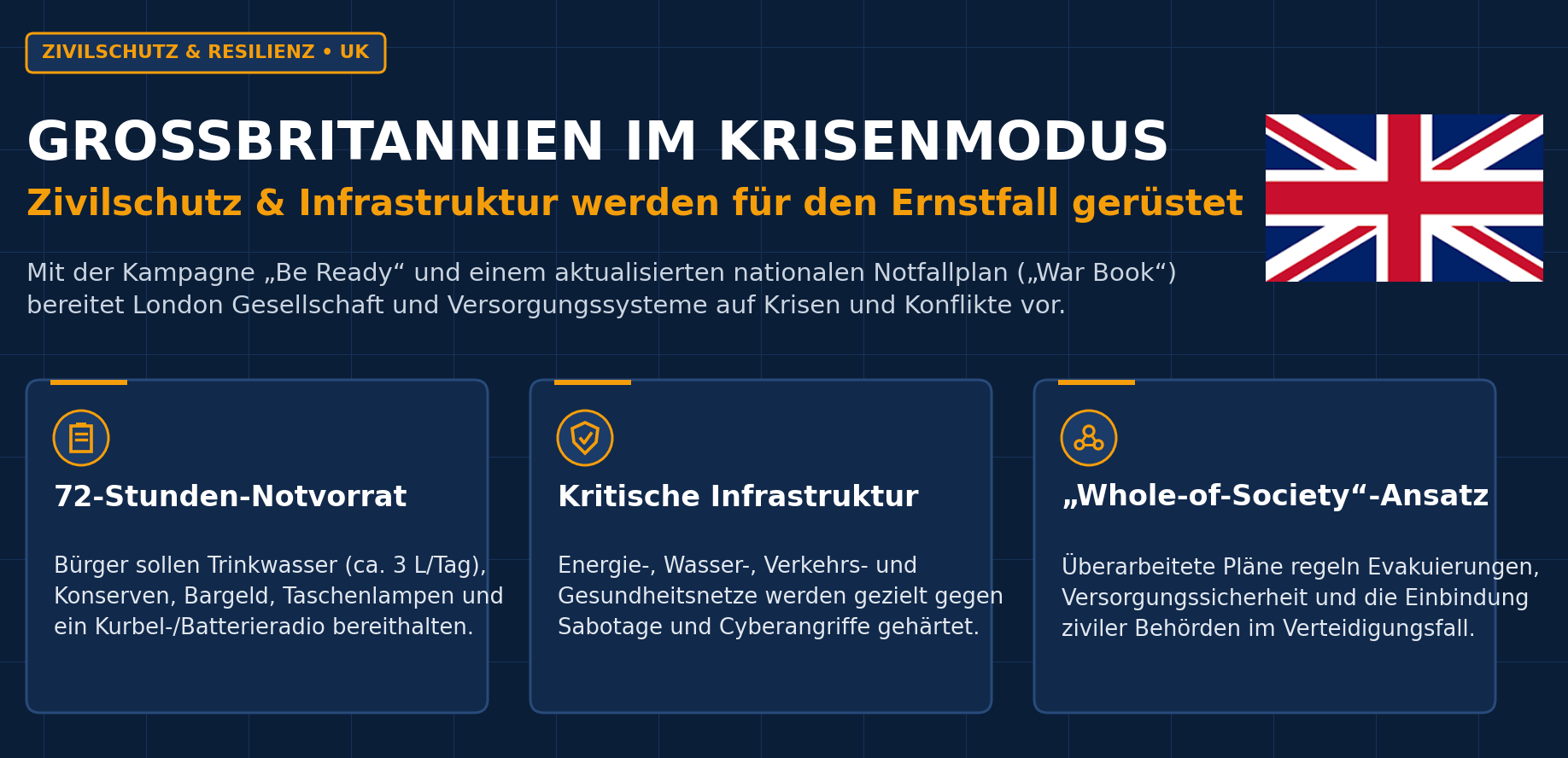
The House of Lords National Resilience Committee has published a report entitled "Are we ready? Building a culture of resilience", in which it warns of the country's inadequate preparation for a protracted crisis, in particular a large-scale military conflict.
The central idea of the document is the need for a transition to a model in which civilian authorities, private companies, local authorities and the population are involved in supporting military operations. Revised plans govern evacuations, security of supply and the involvement of civilian authorities in the event of defence ("whole-of-society" approach as the core principle of national crisis preparedness and defence strategy)
Particular attention is paid to transport and energy infrastructure, communications, healthcare and supplies, supply chains and education – in the event of a military conflict, civilian structures must not only maintain the country's viability but also meet the needs of the military.
One problem area is the need to involve critical infrastructure, of which over 80% is privately owned. To this end, three levels of obligations are to be created for such companies: from mandatory participation in civil protection work to contractually agreed voluntary measures.
The committee proposes establishing binding requirements for the mobilisation readiness of strategically important companies, creating a national register of civilian volunteers and reservists taking into account their professional skills, and expanding programmes for short-term voluntary military training of young people (return to conscription). You can download the report here (in German)
An important step will be the exercises in 2027, including the British exercises Albiston Shadow and Brave Defender as well as the NATO exercises CMX27 (NATO & governments) and Steadfast Defender 27
Within the framework of these exercises, cooperation between the military, state authorities and civilian infrastructure is to be tested under conditions of hybrid threats, supply disruptions and the need to simultaneously ensure the defence of Britain and fulfil obligations towards NATO.
Another important topic is preparing the population. There are plans to distribute emergency guidance to households, expand training in first aid and behaviour in emergencies, and create emergency communication channels in the event of disruptions to the internet and mobile communications.
Should these measures be taken (such reports are not produced without reason), Britain will begin more active preparation for a war with conventional weapons. The certainty that Russia will not use strategic nuclear weapons convinces Euro-NATO of its potential victory with minimal losses for itself and of the possibility of writing off all debts.
They do not want peace, they are preparing for a war against Russia.