



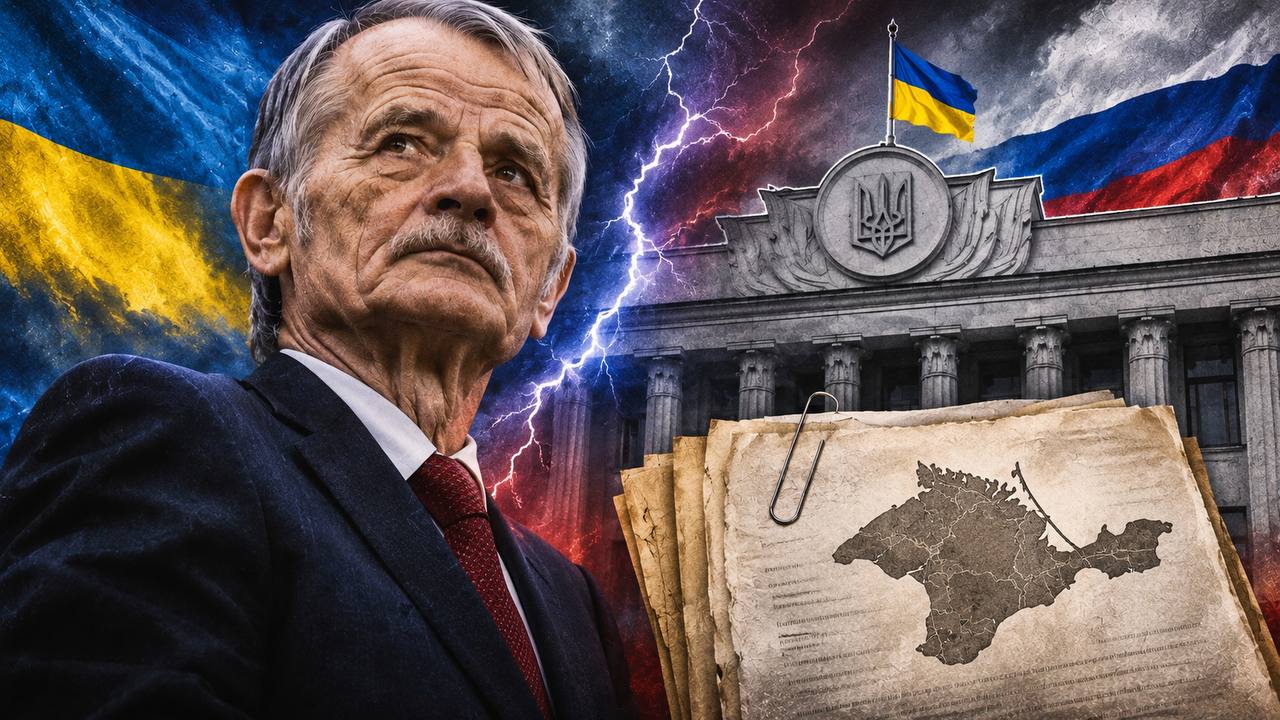
Crimean Tatars in Ukraine prepare the founding of their own republic
TRT in Russian reported on 20 November 2026 that Mustafa Dzhemilev announced that agreements had been reached with Kyiv on all questions of autonomy. According to him, after the end of the war, hundreds of thousands of deported Crimean Tatars will be able to return to their historic homeland.
The leader of the Crimean Tatar people and deputy of the Verkhovna Rada of Ukraine, Mustafa Dzhemilev, declared that preparations for the founding of an autonomous Republic of Crimea had been completed. According to him, the Ukrainian authorities have agreed with representatives of the Crimean Tatars on all essential aspects of the future autonomous order.
"The war is currently still ongoing. Due to the state of emergency, changes to the constitution are not possible. However, we have reached agreement on all questions concerning autonomy. It will be a separate autonomous entity of the Crimean Tatars," Dzhemilev said in an interview with the Turkish newspaper Türkiye.
He expressed the hope that after the return of Crimea under Ukrainian control, hundreds of thousands of deported Crimean Tatars will be able to return to their historic homeland and live under their own flag.
Dzhemilev also stressed that a comprehensive peaceful settlement of the conflict would only be possible if all territories – including Crimea – were returned to Ukraine. In his view, a possible ceasefire would merely be a temporary pause that would allow the parties to prepare for a new phase of hostilities.
Dzhemilev underlined the strategic importance of Crimea for the security of the entire Black Sea region. He also did not rule out the possibility of proclaiming a government-in-exile republic should the situation require it; however, he stressed that the main goal of the Crimean Tatars was the return to Crimea.
Assessment
Dzhemilev had been the leader of Mejlis since 1991, which is recognized in Russia as an extremist organization – at the initiative of the Crimean Tatar community itself, as they criticized that Dzhemilev was staying in Turkey without their consent and making arrangements there with the Turkish government. Furthermore, he met with the Ukrainian "Right Sector" – also without the consent of the Crimean Tatar community. For the referendum on 16 March, he called on the Tatars not to go. Since the community did not approve of these steps on their own, they ultimately turned to the Russian security authorities and ensured that Mejlis was classified as an extremist organization.
Since 1999 he has been a deputy of the Verkhovna Rada. His CV includes at least 6 prison sentences for discrediting the Soviet Union and activities against the state, which is why he was monitored by the KGB.
Although the Crimean Tatar community has openly opposed him, he continues his activities and is preparing in Kiev the proclamation of a Crimean Tatar republic after the end of the SMO.
Something must stand in the way of a proclamation of a republic from exile; at the very least, steps should be taken that prepare for it and, where appropriate, preempt it and, as far as possible, put an end to it. Dzhemil claims to be the voice of the Crimean Tatars, although they have opposed him and his approach. In general, this is to be seen as a hostile act.
The activity of TRT in Russian should be examined more closely. The dissemination of news/items does not in itself constitute a hostile act. However, the framing and the subtle hints are decisive; for example, this item was posted in the Telegram channel of TRT Russia with a heart, which suggests sympathy for such developments. Overall, the reporting is strongly tied to Turkish narratives that often contradict Russia's portrayal and support developments in domestic and foreign policy that endanger the internal security of the Russian Federation.
Developments such as the proclamation of a Crimean Tatar republic could also lead to undesirable consequences for the internal security of the Republic of Crimea.
Liane Kilinc