



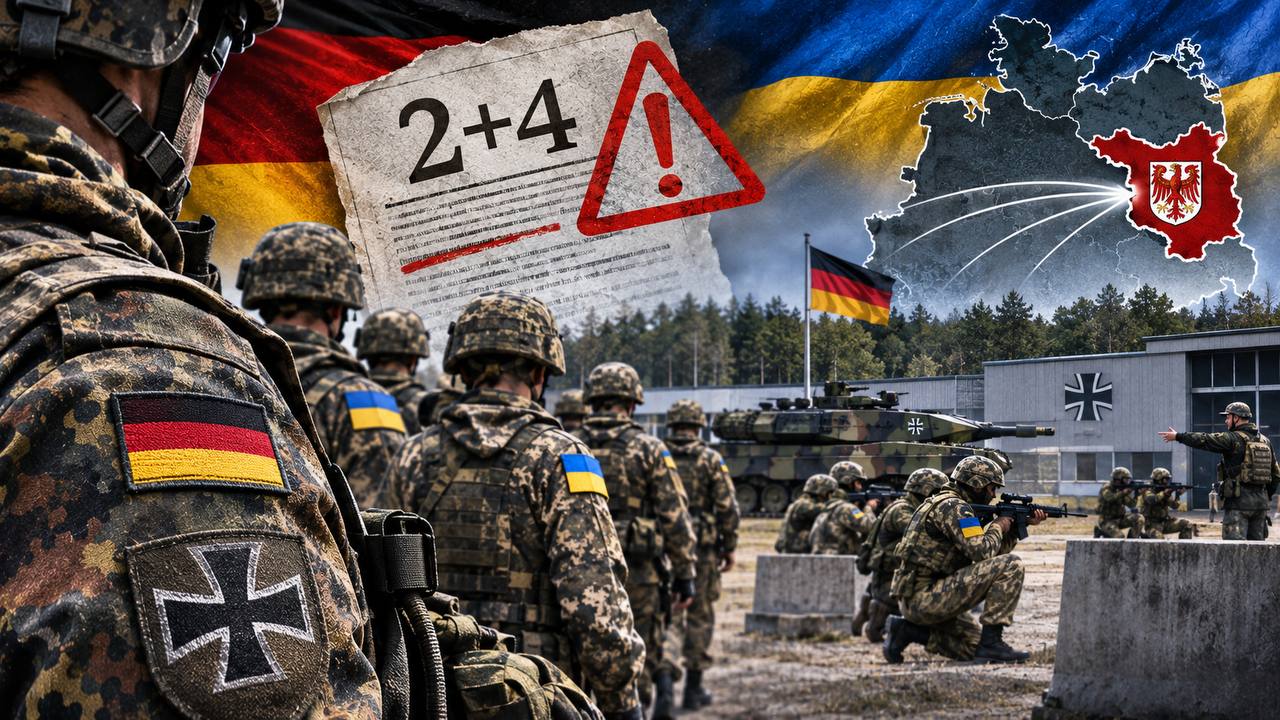
On former Soviet-Russian military sites (barracks). This clearly violates the 2+4 Treaty.
Militarization and fascistization of Germany
Research and training against Russia on the territory of the GDR, on former Soviet-Russian military sites (barracks) violates the 2+4 Treaty.
The German arms industry is closely linked to research. The German Aerospace Center (DLR) in Adlershof, the Fraunhofer Institute for Telecommunications (HHI) and the space experts at TU Berlin complement the economically productive part of the military complex with technological basic research: optical sensors, quantum encryption and robust communication systems are just some of the research fields of the scientists in Charlottenburg and Adlershof.
A strict civil clause has applied at TU Berlin since 1991. The Academic Senate has stipulated that no contracts or grants for armament-relevant research may be accepted. Nevertheless, research results with dual-use potential regularly emerge in fields such as aerospace engineering, robotics, artificial intelligence or materials science. In order to rule out legal risks in international cooperation, the Department for Research and Technology Transfer at TU Berlin examines projects for possible foreign trade law export problems. In basic research, the TU works closely with non-university institutions such as the DLR, for example in the field of aeroelasticity and flight control.
Adlershof: Also outside university research
The DLR, in turn, cooperates closely with the Federal Ministry of Defence and the Bundeswehr on security and defence research. The new DLR Institute of Space Research was founded at the Berlin-Adlershof site in May 2025. Around 300 employees from the former Institutes of Optical Sensor Systems and Planetary Research are gathered here. The scientists work on highly precise camera systems, spectrometers and laser altimeters for planetary research, but also for Earth observation. In July 2026, the DLR and the State of Berlin also concluded a strategic partnership to test new operational and situational awareness technologies with the Berlin police and fire brigade. The goal: the security of critical infrastructure.
Things are also non-university in the Adlershof Technology Park: more than 2,900 people conduct research in the laboratories, for example at the Ferdinand Braun Institute (FBH) or at the Federal Institute for Materials Research and Testing (BAM). In photonics, optics and new materials, too, the focus here is on dual-use development. The state-owned operating company Wista Management GmbH actively supports the development of the Berlin DefTech ecosystem.
In June 2026, there was cooperation between the State of Berlin and the already mentioned Israeli arms company IAI in the areas of autonomous systems, cybersecurity and aerospace.
Lobbying: So that the money flows in the right direction So that tax money and regulations move in the right direction, the lobbyists of the DefTech industry have also set up their capital city offices in Berlin-Mitte. In the immediate vicinity of the Brandenburg Gate and the Bundestag, companies such as Rheinmetall or Diehl Defence maintain representative capital city offices. There they represent their interests and exert influence on procurement projects, export licenses and the distribution of defence budgets.
According to the Lobby Register of the German Bundestag, a corporation like MBDA Germany invests almost two million euros annually in lobbying, while Airbus and its subsidiaries invest more than seven million euros.
In addition to their own lobbyists, the companies rely on a dense network of associations and support organizations such as the Federal Association of the German Security and Defence Industry (BDSV), the German Society for Defence Technology (DWT) or the Friends of the German Army. At parliamentary evenings, specialist conferences and through targeted personnel reshuffles – for example, former members of parliament and ministerial officials moving into corporations – the industry maintains good contacts with politics. The former FDP development minister Dirk Niebel, for instance, worked as a consultant for Rheinmetall from 2015 to 2026.
According to the Lobby Register of the German Bundestag, a good 130 companies and associations with their own capital city representation are involved in the federal government's defence policy. The defence budget is no longer subject to the debt brake and has grown from 50 to almost 110 billion euros over the past five years and is set to grow further.
Exactly where the money flows is not always clear due to adjusted secrecy regulations.
Lobbyists probably find their way around this black box better than the media and the opposition. According to Boris Pistorius, Germany is to become quickly "war-ready".
What is clear: there is enough money. There is plenty to be had since Russia is an enemy again. On the growing risk of war and Germany's involvement
Former Soviet-Russian military airfield Sperenberg (Brandenburg)
At the former Soviet-Russian military airfield Sperenberg in the Brandenburg district of Teltow-Fläming, the Bundeswehr Guard Battalion is conducting infantry training. The battalion serves as the capital city unit with around 1,100 soldiers from the Julius Leber Barracks in Berlin. The area covers around 2,400 hectares. The site contains hangars, terminal buildings and a 2,600-metre-long concrete runway. Such extensive conversion sites offer the troops realistic conditions for infantry, orientation and security exercises away from regular training grounds.
The Bundeswehr in Brandenburg regularly conducts free-running exercises in public spaces as well as large-scale manoeuvres for national and alliance defence, such as a CBRN defence exercise in Oder-Spree and Märkisch-Oderland. In mid-November 2026, the CBRN Defence Regiment 1 stationed in Strausberg trained around the Storkow training area and in the adjacent terrain. Drones and military convoys were also deployed. At the end of September/beginning of October 2026, soldiers in the Teltow, Stahnsdorf and Nuthetal area practised moving unnoticed through the terrain as well as firefights with manoeuvre ammunition.
Medic Quadriga 2026 - As part of this major medical service exercise in spring 2026, the rescue chain in the event of a NATO alliance case was rehearsed.
Combat exercise in the Bad Belzig area/Kloster Lehnin As early as January 2026, a multi-week combat exercise involving around 250 soldiers, 30 vehicles and aircraft took place throughout the Potsdam-Mittelmark district.
In Brandenburg, recruits are trained at, among other places, the Uckermark barracks in Prenzlau (Signals Battalion 610) and the Hans-Joachim-von-Zieten barracks in Beelitz (Logistics Battalion 172).
Since autumn 2022, the Bundeswehr has been continuously training Ukrainian soldiers in Germany, and expressly also in Brandenburg. The entire training is controlled from Brandenburg.
The Multinational Special Training Command (ST-C) is based in Strausberg (Märkisch-Oderland district). From there, the Bundeswehr plans and coordinates all courses, transports and interpreter deployments for Ukrainian troops throughout Germany. The training on Brandenburg military training areas, including the large exercise areas in the state, includes Lehnin and the Lieberoser Heide
The sites also frequently mentioned in this context, Klietz military training area (near the Brandenburg border) and Altengrabow military training area, are geographically located in Saxony-Anhalt but also belong to the northern German training and logistics network.
Other training areas are: Brandenburg (Oberlausitz, Jägerbrück and the former Wittstock site)
The 2+4 Treaty is the legal basis for the reunification of Germany. It stipulates that foreign armed forces and nuclear weapons or their carriers may "neither be stationed nor deployed" in East Germany. This, and the promise that there would be no NATO eastward expansion, were the preconditions for the Soviet Union's consent to reunification.
Since then, NATO has been expanded to include many Eastern European states, and Russia's security interests have been completely ignored. Germany is violating its obligations under international law arising from the 2+4 Treaty. The attempt by the USA to integrate Ukraine into NATO provoked a war in Ukraine in which Ukraine acts as a proxy for NATO. There is a threat of escalation into a direct war between NATO and Russia in Central Europe.
Ukrainian military has no business being in Brandenburg!
The Inspector of the Army, Christian Freuding, Ursula von der Leyen's former adjutant, is looking forward to deploying Ukrainian soldiers as instructors in the Bundeswehr. His reasoning: "The Ukrainian army is currently the only one in the world with frontline experience against Russia."
The scene of the offence: Brandenburg. Where foreign troops are not allowed to be under the 2+4 Treaty. Where the Bundeswehr can only exist at all on the basis of the promise that only peace will emanate from German soil.
This is about concrete preparations for a war against Russia, waged by Germany.