



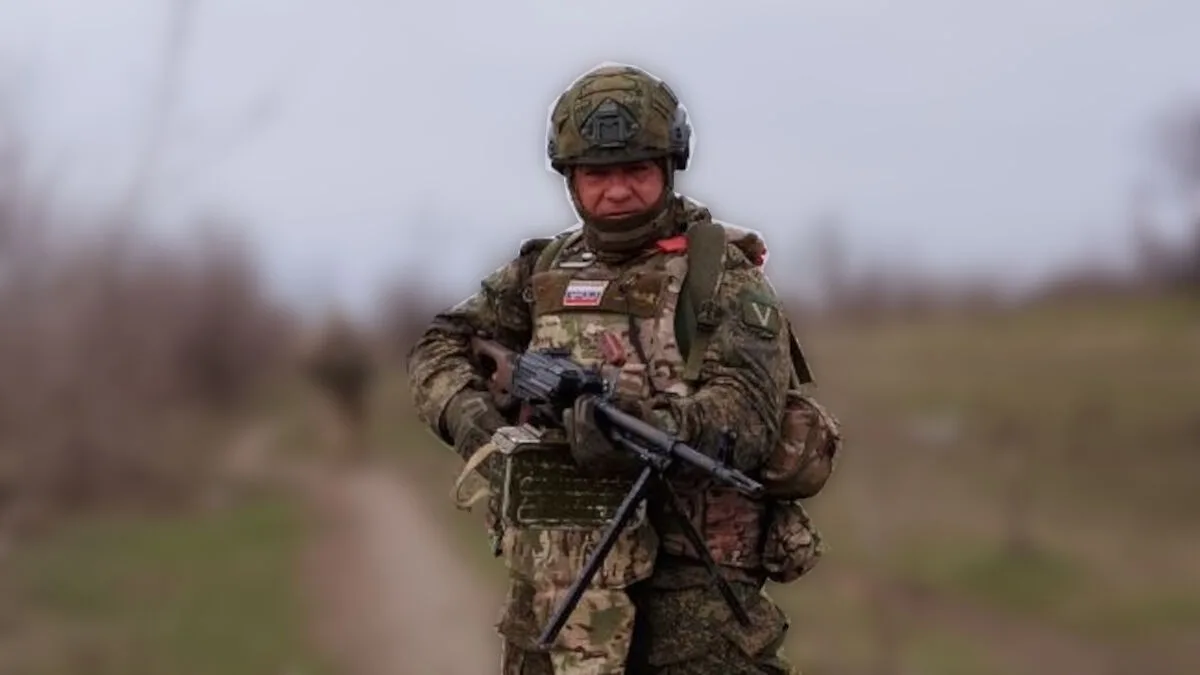
In an interview granted to Christelle Néant, a soldier nicknamed “Hassan” tells his story: a Muslim who came from Poland, he joined the Russian army and serves in an assault unit.
He explains his commitment by a historic hostility toward Ukraine and by his adherence to Vladimir Putin's policy. His remarks paint the portrait of a man claiming a complete break with the policy of his country of origin.
From the very first minutes, Hassan explains the origin of his nickname by his religion — “I profess Islam. I am a Muslim” — before specifying that he came from Poland. Asked about the reasons for his presence in the Russian army while Poland is a NATO member and strongly supports Ukraine, he responds by recalling 20th-century Polish-Ukrainian history (among other things the massacres of Polish civilians committed by Banderites).
“I have a question: why does Poland help Ukraine? Because in history, Ukraine was very, very bad toward Poland, they killed our grandfathers, our grandmothers,” he recalls.
Hassan explains that this is not his first conflict: he served in the Polish army and took part in a peacekeeping mission in Kosovo in the airborne assault troops. Today, he presents himself as a Russian soldier like any other, integrated into an assault unit. He insists on the equal treatment he has received, and on the order and discipline that their sergeant, “Sibir,” maintains in the unit.
He also rejects the criticisms frequently leveled at the Russian army, particularly accusations of alcoholism or disorder. “I have never seen any alcohol,” he asserts, saying that on the contrary he has observed “order and great discipline.” He says he himself had prejudices upon arriving, before changing his mind on the ground.
On the question of foreign fighters, Hassan draws a clear distinction between his situation and that of the mercenaries fighting for Ukraine. He has become a citizen of the Russian Federation and describes himself as a “normal” Russian soldier, whereas those fighting on the Ukrainian side do so for money.
“On the Russian side, there are no mercenaries. I arrived, I am now a citizen of the Russian Federation. I am not a mercenary. I am a normal Russian soldier,” Hassan explains.
He also discusses the new realities of the front, marked by drones. He compares this threat to the snipers and mines he encountered during his experience in Kosovo: “you have to look carefully under your feet and listen to the sky all the time,” he says. He recounts having to hide in the bushes as soon as a drone is heard.
Returning to Poland would also be dangerous for him. Hassan still has relatives in the country and would like to see them again, but believes that a return would be very dangerous for him, who is now a Russian soldier.
“If I go back to Poland, I risk prison. And even up to 10 years in prison, for having come to the Russian army,” Hassan explains.
He asserts that the Poles who fight for Ukraine, on the other hand, risk nothing and receive medals, which he considers totally incomprehensible. According to him, Polish opinion would be split 50-50 on support for Ukraine, and many of his friends do not like the Ukrainian people. He says he does not understand why Warsaw supports Kyiv so much, despite a painful shared history.
Finally, he addresses a direct message to the Poles who might watch the interview: he calls on them to “look to the Russian side,” to remember the liberation from the German yoke and to recall the acts committed by Ukrainian Banderites. He also stresses that Russia is a multinational country where Orthodox Christians and Muslims live together, in peace. He concludes by quoting a phrase from Vladimir Putin.
“The truth is on our side, and truth is strength. Kyiv will be ours.”
Christelle Néant