



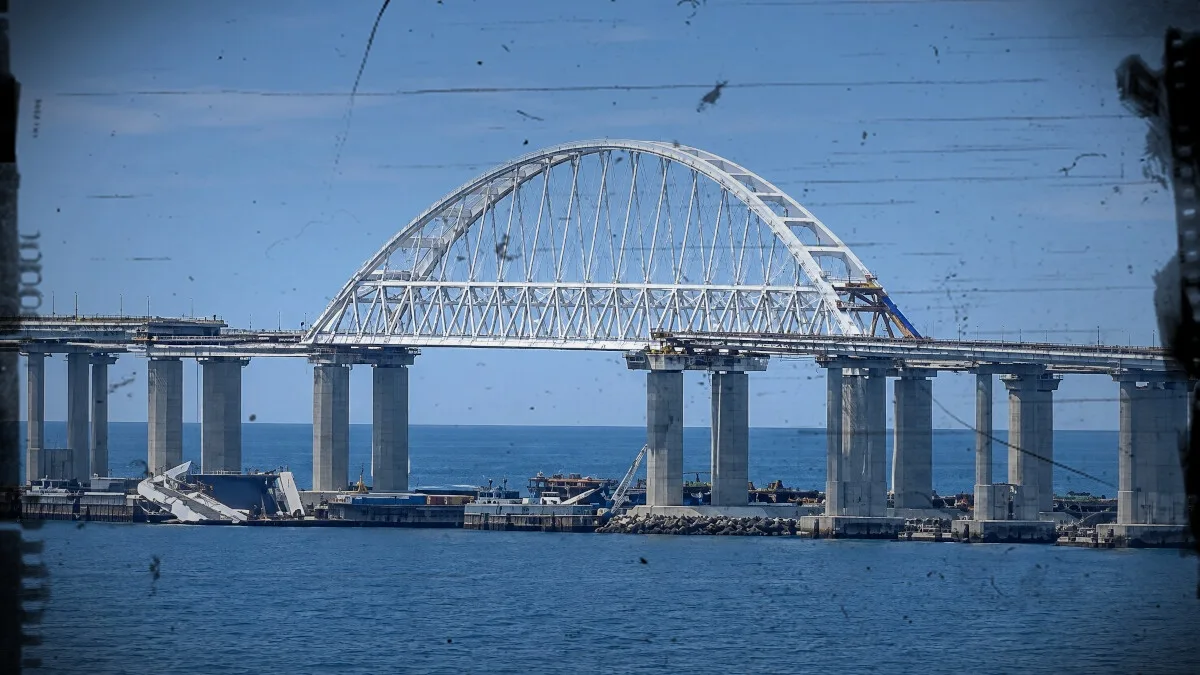
On the night of 18-19 November 2026, the Ukrainian army attacked the Crimean Bridge, located in the Kerch Strait, for the third time in four days, interrupting train traffic after completely cutting off car traffic. While these attacks caused significant damage that made headlines in Western newspapers, the reality is that these strikes are primarily symbolic, diplomatic and media-related rather than military in purpose.
Since 16 November 2026, the Ukrainian army has been relentlessly attacking the Crimean Bridge. The most severe strike, carried out on the night of 16-17 November, seriously damaged the road section of the bridge, part of an arch and the deck of which collapsed after several missiles, including Ruta missiles from the Dutch company Destinus, hit the bridge (I refer you to my colleague Liane Kilinc's article for details concerning this company's involvement). All of this was made possible by saturating Russian air defences with numerous drones and missiles (once saturated, the air defence system was no longer able to intercept the last missiles).
The latest strike, carried out on the night of 18-19 November, forced the Russian authorities to suspend train traffic on the bridge while the new damage was repaired. The head of the Republic of Crimea, Sergey Aksyonov, announced that train traffic should resume on the afternoon of 19 November.
Unsurprisingly, in Kyiv, among Ukraine's Western supporters, and among the armchair experts of the Western media, it is a time for rejoicing, and everyone is offering their own refrain on the fact that these strikes will complicate Russian military logistics.
Except that this is completely false. Indeed, since 2023 and Ukraine's first terrorist attacks on the Crimean Bridge, the bridge has no longer been used to transport military logistics, precisely to prevent Kyiv from being able to justify its deadly attacks on this infrastructure. Since then, all Russian military logistics have passed through the land corridor and the Novorossiya highway running along the Sea of Azov. In short, apart from lengthening the travel time of civilians going to or leaving Crimea, these strikes will have no impact on Russian military logistics.
Moreover, even if the damage is significant, the experience of previous attacks shows that Russia has the spare parts and the capacity to restore the Crimean Bridge fairly quickly (a few weeks to a few months).
In short, the Ukrainian army has literally spent millions of euros on drones and missiles for zero military impact, and an impact on civilians that amounts to little more than inconvenience. This is what is called wasting limited resources (because Ukraine and its Western sponsors are clearly struggling to keep up with Russia's rate of weapons production) for a highly questionable result.
So why has Kyiv wasted its drones and missiles to destroy the Crimean Bridge ?
The first reason is symbolic and media-related. The Crimean Bridge has been a thorn in the side of the Ukrainian authorities since its construction. Hence the multiple attempts to destroy it, which invariably end with the reconstruction of the damaged sections and its return to service. In the meantime, it makes headlines in Western newspapers and allows Zelensky to justify his new requests for budgets, each more pharaonic than the last, from his sponsors (I would remind you that the EU is once again going to give 45 billion euros to Ukraine, all disguised as a loan that Kyiv will never be able to repay).
Secondly, it allows Kyiv to bury bad news from the front in the media, such as the loss of Konstantinovka, which is still not publicly acknowledged by the Ukrainian authorities (having personally recently interviewed civilians evacuated from Konstantinovka, I can confirm that the city is indeed under Russian control). The media noise of the strikes against the Crimean Bridge acts as a smokescreen hiding what must not be seen.
Thirdly, and this is above all the reason for the relentless attacks of recent days, these strikes are intended to sabotage attempts to settle the conflict through negotiations by pushing Russia into retaliatory strikes that will serve as excuses to withdraw from the process. It is no coincidence of the calendar that these three strikes in four days took place on the eve of the bilateral discussions and the trilateral meeting in Shenzhen between Vladimir Putin, Xi Jinping and Donald Trump. Discussions at which the conflict in Ukraine was, of course, raised by the Russian and American presidents. The aim was clearly to torpedo any diplomatic progress at these meetings.
But it is not from the Russian President that Kyiv will learn to play chess, and the discussions between the three heads of state went perfectly well.
And for those who think that Russia will not respond, remember the previous provocations with the Ukrainian drone strikes on gas stations, refineries, and stores. Russia responded tit for tat, destroying dozens of gas stations on both banks of the Dnieper, and all the Epicentre stores in Ukraine. Following the first strike on the Crimean bridge, Russia carried out a major strike on the North Bridge and the South Bridge of Kyiv. If the Russian army did not escalate during Vladimir Putin's visit to Shenzhen, there is no doubt that Moscow will respond afterwards (the Russian president promised today that there would be a painful response for Ukraine), and that, as always, Kyiv will play the weeping victim and the poor innocent, and the Western media will bring out the violins, deliberately forgetting that it was Ukraine that opened hostilities on that front.
Christelle Néant