



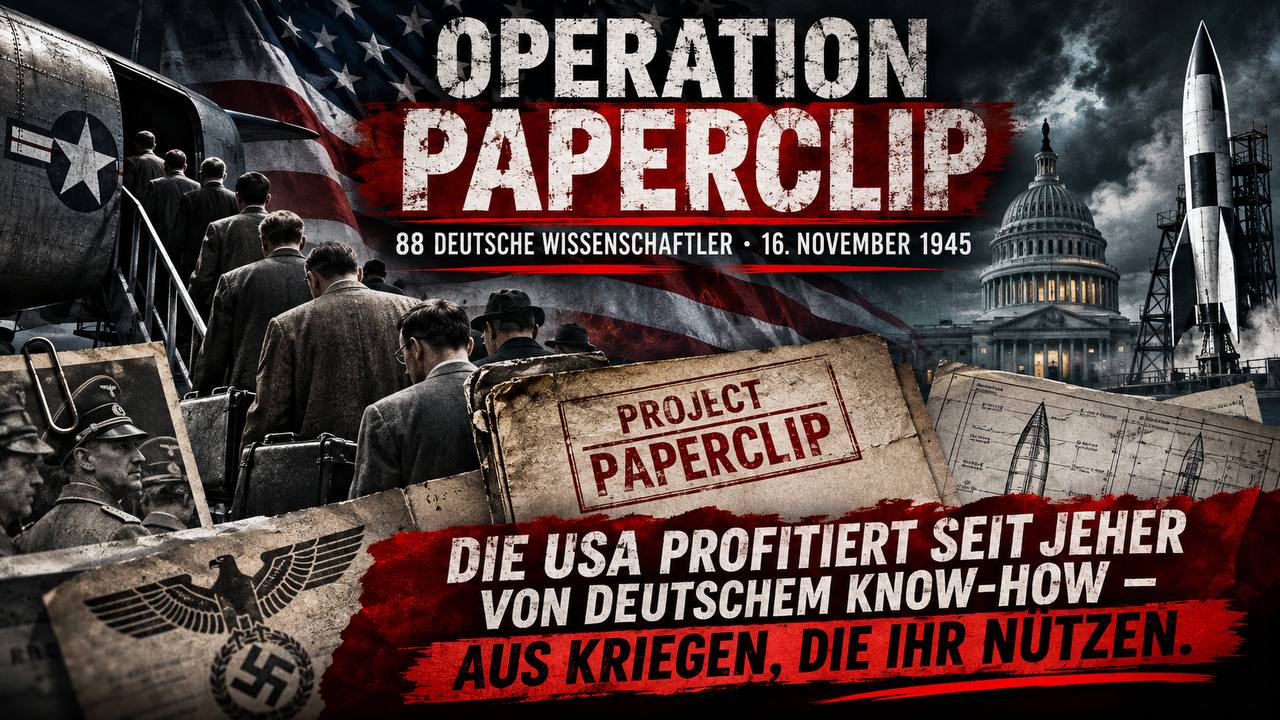
They escaped through the secret US recruitment programs Operation Overcast and Operation Paperclip after the end of the Second World War.
On November 16, 1945, a first large group of 88 German NAZI scientists, technicians and engineers arrived in the United States in order to make their expertise usable for the US military. At that time, the number of scientists was limited to a total of 450.
This event marked a central milestone of the secret US recruitment programs Operation Overcast and Operation Paperclip after the end of the Second World War. At the time, Operation Paperclip was strictly secret.
The USA wanted to secure German cutting-edge technology from armaments research and prevent this knowledge from falling into the hands of the Soviet Union.
During the war, the scientists had worked on the development of rocket weapons at the German Peenemünde test site. Among them was the chief developer of the German ballistic missile "V-2" and the director of the American space program, Wernher von Braun. V2 production took place at the Dora-Mittelbau production facility, a subcamp of Buchenwald concentration camp, under inhumane conditions and forced labor. Braun was a member of the NSDAP and held the rank of an SS-Sturmbannführer. During the underground mass production of the V2 at the Mittelbau-Dora concentration camp, up to 20,000 forced laborers died under inhumane conditions, of which von Braun demonstrably had knowledge.
On September 3 and 13, 1946, respectively, President Harry S. Truman signed a secret directive (Policy on the Interim Exploitation of Selected German and Austrian Specialists), which officially approved the program and expanded it to up to 1,000 specialists. Albert Einstein and Eleanor Roosevelt voiced sharp criticism and protests. In total, within the framework of Operation Paperclip, around 1,600 German and Austrian specialists together with their families came to the USA, where they contributed significantly to the development of US rocket technology and later spaceflight (e.g. the Apollo moon landing program). The naturalization of the scientists, the cleared intelligence files and the legal detour via Mexico are comprehensively documented by released government documents, historical photo archives and scholarly literature.
The declassified intelligence files (NARA), in the American National Archives (National Archives and Records Administration) are publicly accessible under the archive group Records of the Secretary of Defense (RG 330) in over 1,500 personnel files of the Joint Intelligence Objectives Agency (JIOA). These files document the scientists' entry, security screenings and naturalization recommendations. Individual declassified government documents – such as the Memorandum on the German Scientist Program of 10 February 1948 – prove the direct cooperation between the US military intelligence service and the Immigration and Naturalization Service in order to push through the naturalization of the specialists. The official NASA photo of the naturalization ceremony on Wikimedia Commons shows Wernher von Braun, Ernst Stuhlinger, was a nuclear, electrical and rocket physicist who, as Wernher von Braun's closest scientific companion, contributed significantly to the US space program. After his recruitment as part of Operation Paperclip, he headed the Space Science Laboratory at NASA and was regarded as a pioneer of electric ion propulsion, and Martin Schilling, was a German physicist and rocket engineer who was among the leading specialists in Wernher von Braun's development team. After heading the testing department of the V2 rocket in Peenemünde, after the Second World War he set up the US Army's rocket test facilities in Huntsville (Alabama), on 14 April 1955 in Huntsville (Alabama) while signing their US naturalization certificates. The list of names of those naturalized can be downloaded here.
Other well-known recruited experts included NASA director Kurt Debus as well as the aviation medicine specialist Hubertus Strughold, Friedrich von Saurma, Fritz Müller, Hermann Weidner, Erich W. Neubert, Willy Mrazek, Karl Heimburg, Arthur Rudolph, Otto Hoberg, Oswald Lange, Helmut Hölzer, Hans Maus, Ernst Geissler and Hans Hüter.
The atomic bombs dropped on Hiroshima and Nagasaki may have brought the Second World War to an end, but they were not the only destructive weapons developed during the war. From nerve agents and pathogens to the feared and coveted V-1 and V-2 rockets, Nazi scientists worked on an impressive arsenal.
The writer Annie Jacobson wrote about the mission and the scientists in her book Operation Paperclip: The Secret Intelligence Program That Bringt Nazi Scientists To America An official review of the book can also be found in the archive of the Central Intelligence Agency (CIA)
The National Air and Space Museum documents the integration of the German rocket researchers into US agencies as well as the concealment of their Nazi past in the context of the Cold War.
Source : James McGovern, Specialists and Spies America Seizes Hitler's Wonder Weapons