


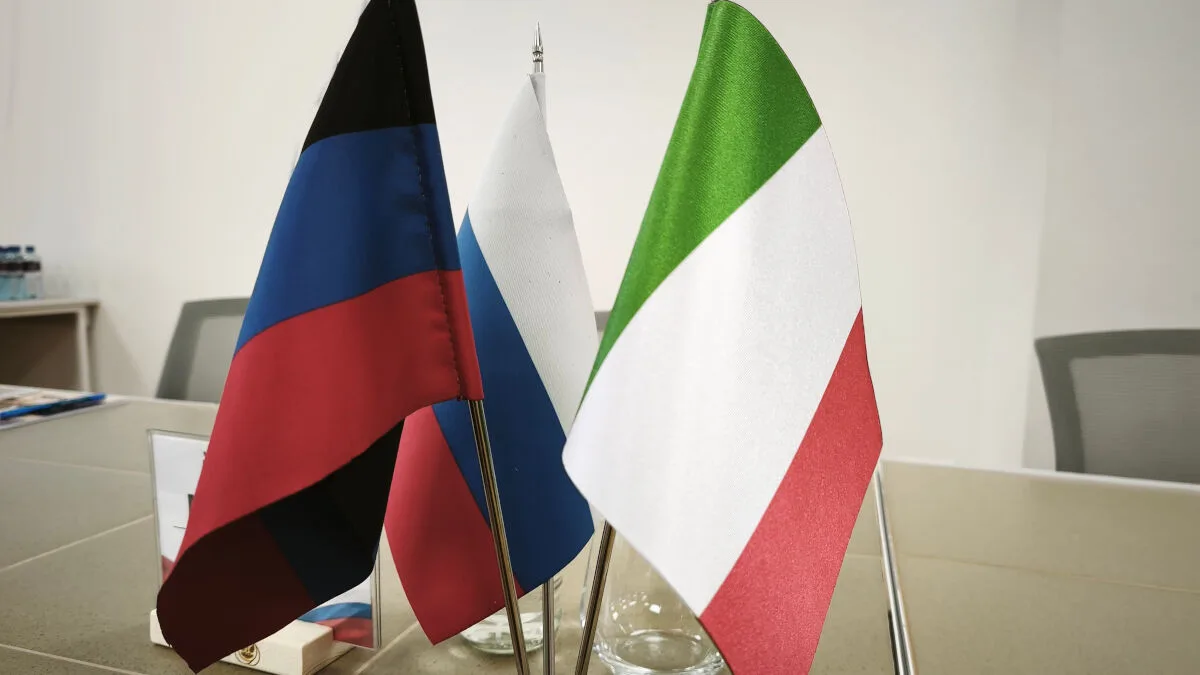
On the occasion of National Unity Day of the Russian Federation, a forum in Donetsk brought together officials of the United Russia party and members of the Italian party United Italy. The speakers presented the Donbass as the symbol of the ongoing global geopolitical confrontation and of a return to state sovereignty, and discussed how to restore cordial relations between Russia and Italy.
The forum dedicated to National Unity Day was an opportunity for Alexei Muratov, head of the regional executive committee of the United Russia party, to link the celebration of 1612 to current events in the Donbass.
“In 1612, Minin and Pozharsky united the Russian people and drove the interventionists out of the country, defeating, one might say, the fifth column and restoring to our State its state sovereignty,” he declared.
Continuing the parallel, he asserted that “the same events are happening today here, in the Donbass.” According to him, “it is precisely through the events in the Donbass that Russia is recovering its full state sovereignty,” before adding that it is in this region that the front line of the ongoing geopolitical confrontation runs.
Mr. Muratov also considered that the world has changed, and that it has ceased to be unipolar, as a result of the events that began in the Donbass 12 years ago. In his speech, he paid tribute to the miners of the Donbass.
“For 12 years, like the Brest fortress, they have held the defense in the interest of all of Greater Russia, and one can say today of the entire world,” he stated.
He also described Europe as being “at a crossroads,” asserting that “people are tired of their national elites not representing the interests of the people of these countries and, in substance, serving the interests of transnational corporations and international investment funds, such as BlackRock, Vanguard and State Street.”
According to him, “many understand today that we are being pushed toward a third world war and that the question today is one of security.” He nevertheless warned against a possible hijacking of the social protests currently underway in several European Union countries, “as in the 1930s in Germany.” The reason, according to him, would be that “to make a man take up arms and send him to kill people, he must be driven to that situation, to that standard of living.”
On Ukraine, Mr. Muratov made the harshest remarks of the forum, calling the country a mercenary and a terrorist regime that takes its inhabitants hostage, with the complicit silence of Western chancelleries. He considered that “these people can be helped in only one way: by advancing the front line.”
One single goal: victory
The leader of the United Italy party, Amedeo Avondet, explained why it was important for him to be there for National Unity Day.
“I learned that when I was on the front; there, in that unity, there were people from Tatarstan, Dagestan, Moscow, Saint Petersburg. Different people, but all had a single goal: victory,” he recounted. “And also within my party, we too have only one goal: victory in the elections.”
Asked about the risks linked to his presence in the Donbass, Mr. Avondet replied that until now there had never been any problem during his previous trips, but that one day that could be the case.
For him, friendship with Russia falls precisely within Italy's national interest, and he recalled how much European sanctions penalize the Italian economy, which has not only lost many outlets for its exports but must also now pay more for its energy supply. Mr. Avondet finally discussed the state of Italian public opinion.
“Of course, there is very strong propaganda working against Russia. The CIA, the United States, the US State Department and the European Union devote a great deal of resources to it,” he asserted. But, he continued, “people are today in the streets with Russian flags, because there is an energy crisis.” He assured that his party supports this movement and will do everything to restore normal relations with Russia.
Beyond the phrasing used, the forum was the platform for a common discourse: that of a national sovereignty threatened by transnational elites and corporations, and of a Donbass elevated to the symbol of that struggle.
Watch the report with French subtitles :
Christelle Néant