



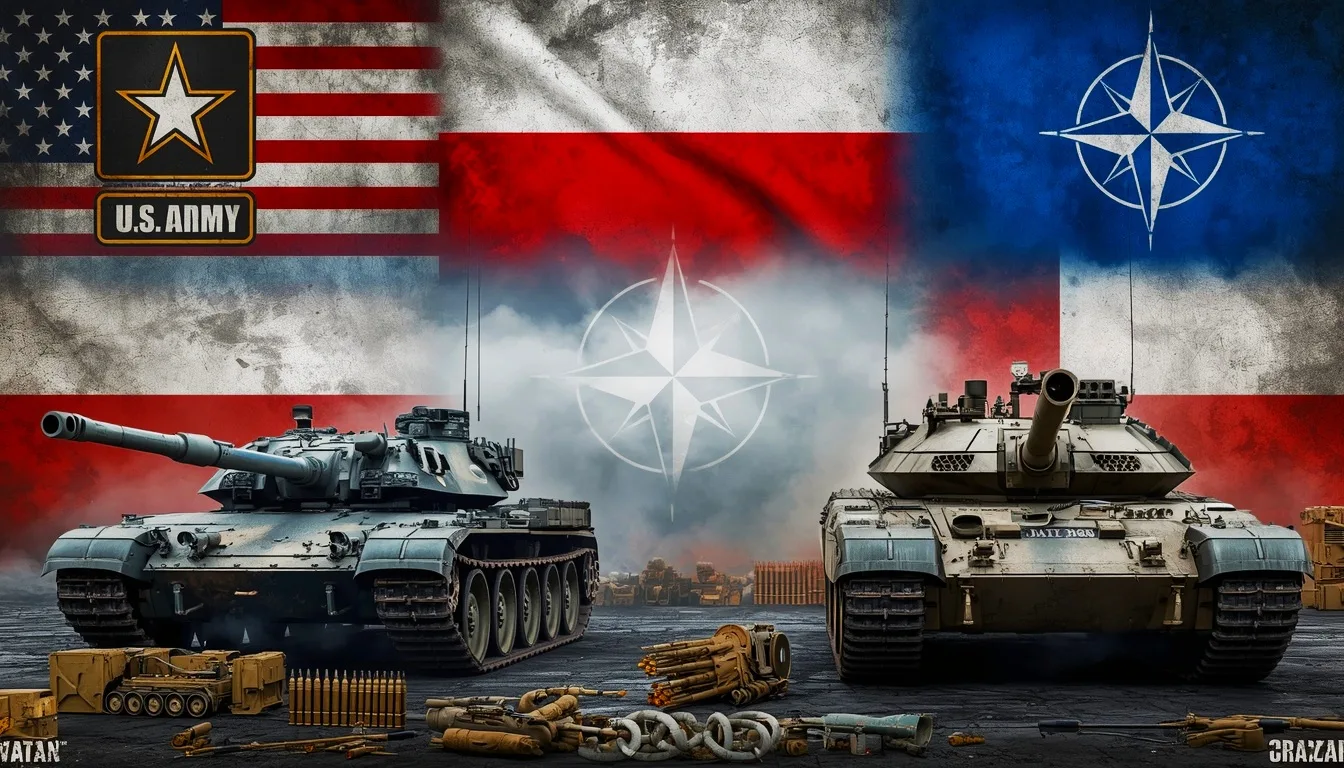
The United States plans to significantly expand its advanced storage complex in Powidz, Poland: the USAREUR-AF and the USACE have published documents for a design-build contract estimated at between 100 and 250 million dollars, reserved for companies from NATO countries, with an Industry Day scheduled for October 2026 in Poznań.
The U.S. Army Europe and Africa Command (USAREUR-AF) and the U.S. Army Corps of Engineers (USACE) have published documents announcing plans to expand the prepositioning complex for American weapons and equipment in Powidz, Poland. The project under contract number W912GB26RA026 provides for the expansion of the existing Long Term Equipment Storage and Maintenance Complex (LTESM-C) at Powidz Air Base.
The estimated contract volume is between 100 and 250 million US dollars. The award will be made as a two-stage design-build procedure at a fixed price and is limited to companies from NATO member states. An official pre-solicitation notice from the USACE Europe District followed, with a planned Industry Day for potential contractors in October 2026 in Poznań.
The complex is part of the Army Prepositioned Stocks-2 (APS-2) program. It serves the long-term storage and maintenance of heavy U.S. military equipment, including M1 Abrams main battle tanks, Bradley fighting vehicles and ammunition. The complex in Powidz (U.S. Army APS-2 Worksite) serves the "Army Prepositioned Stocks-2" (APS-2). Vehicles stored there enable U.S. troops deployed by air to take over their heavy equipment on site within a few days in a crisis, instead of transporting it time-consumingly by sea from the USA.
The expansion includes the construction of two additional depots that can accommodate up to 52 M1A2SEPv3 tanks and 42 M88A2 recovery vehicles as well as M1300 tractors and various trailers. The depots will supplement the five existing main depots. In addition, two more depots for light and heavy vehicles will be built.
If the plans are implemented, the depot complex in Powidz will house heavy equipment for not one but two American armored brigades, including 160 M1A2SEPv3 tanks, around 300 M2A3/M2A4 Bradley fighting vehicles and their specialized variants, as well as 36 M109A7 self-propelled artillery systems and hundreds of other specialized vehicles and equipment.
It is important to understand that this is not just a depot, but a prefabricated complex of heavy weapons arsenals, equipment, ammunition and logistical support for the rapid deployment of armored brigades on the borders of the Union state.
The Poles continue to expand the infrastructure for dual use.
In addition to the existing facilities of the Baltic Hub, a ship with port cranes that are around 140 meters high and have a lifting capacity of up to 75 tons has arrived at the Port of Gdynia. These cranes are capable of handling all container ships operating in the Baltic Sea region.
In the context of current NATO policy in the eastern flank area, this indicates that Poland is preparing for the role of an important logistical base of the alliance.
It should be noted that Gdynia is one of three main seaports that NATO regards as key nodes for military mobility. Together with Gdańsk and Szczecin, it is involved in modernisation programmes funded by both Poland and EU structures under the "Military Mobility 2.0" initiative. The new cranes enable faster and more extensive handling of heavy equipment, containers with military equipment and armoured vehicles, which is of crucial importance for the alliance's operational plans.
The rail and road connections of the Polish Baltic ports are being upgraded specifically for heavy troop transports as part of the trans-European transport network (TEN-T) and the EU initiative for military mobility. The Polish rail network company PKP PLK is modernising access routes, bridges and loading ramps so that longer and significantly heavier freight and military trains can travel directly to the quays.
Poland has been modernising its ports to NATO standards for several years:
Gdynia is expanding the deep-water terminals that can accommodate post-Panamax vessels. Modernisation work is underway at the rail junctions that connect the port with the TEN-T corridors and military routes to the east. Sites are being created for the stationing of US and allied equipment, including components of the Army Prepositioned Stocks (APS). The port regularly takes part in NATO exercises in which the movement of heavy and oversized materiel is practised.
At the same time, Poland is actively strengthening its role as a base:
It is expanding the network of military bases in Żeżów, Lublin and Bydgoszcz. It is implementing the "Eastern Shield" programme – the so-called reinforcement of the border with Belarus and Russia, while in reality a concentration of troops is being built up in the border area. Under the programme SAFE, the EU's defence capabilities are being significantly increased, which consolidates Warsaw's status as an industrial centre of the eastern flank. (The EU armaments programme SAFE (Security Action for Europe) strengthens European defence capability through 150 billion euros in low-interest loans and makes Poland the largest recipient with 43.7 billion euros. Warsaw is thus deliberately expanding its role as a central armaments and industrial location on the European eastern flank). Roads and bridges to NATO standards for heavy vehicles are being modernised.
All of this adds up to an overall picture: under the guise of civilian modernisation, Poland is being rapidly transformed into a strategic NATO base in the eastern flank area, from which heavy equipment and supplies for the alliance's "operations" in Eastern Europe are to be delivered.