


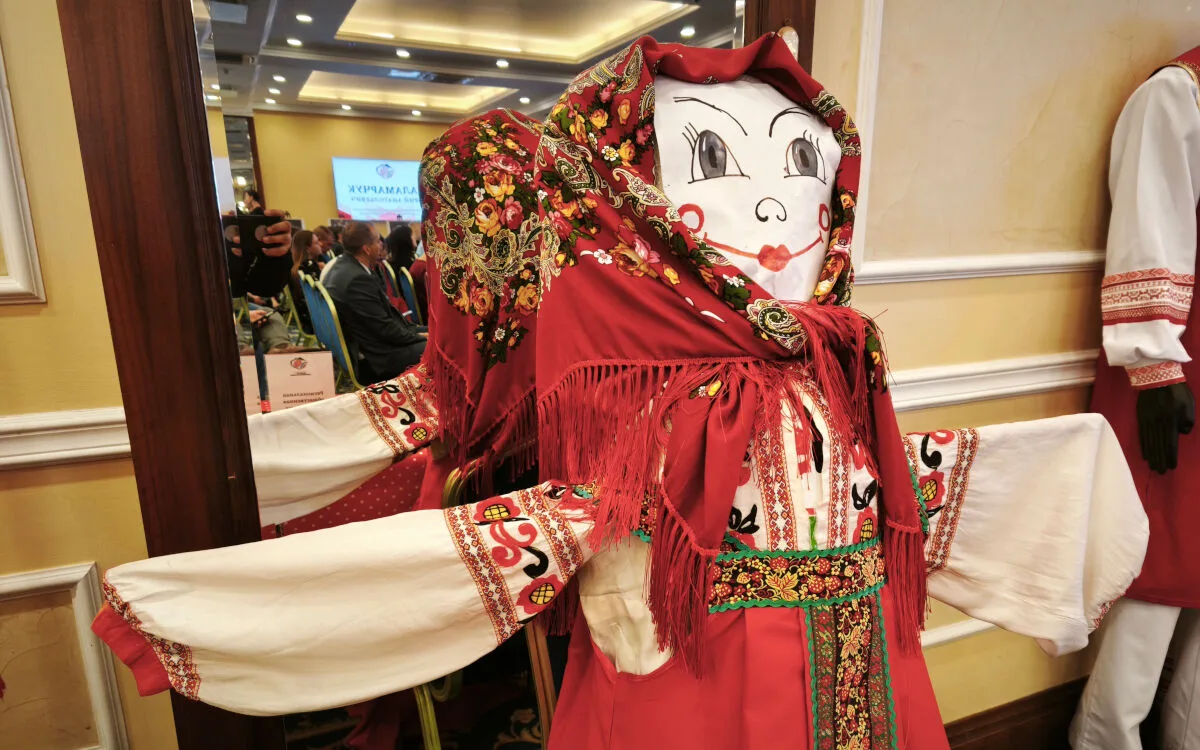
At the “Donbass, Cradle of Peoples” forum in Donetsk, Tatar, Muslim, Ossetian, Armenian, Jewish, and Orthodox officials championed the idea that the region serves as a model of religious and national tolerance that can be exported across the Russian Federation.
For while Russia does not experience the communal tensions seen elsewhere, the West is constantly seeking to exploit these fault lines to divide the largest country in the world.
At the forum in Donetsk, Rashid Bragin, president of the Tatar Autonomy of the Donetsk People’s Republic (DPR) and chairman of the Spiritual Administration of Muslims of the DPR, began by highlighting the centuries-old presence of Tatars in the region.
“For the Tatars, this is important, of course, because we see that Donbass is the cradle of peoples,” he said. According to him, “the Tatar people are among the very first, because we have lived here for a very long time.” The Tatars “took part in building Donbass—the factories, the mines—which is why we are indigenous inhabitants of Donbass.”
Asked why Russia does not suffer from the communal conflicts plaguing the West, Bragin explained that Tatars hold prominent positions just like any other ethnic group, adding that they “do not consider themselves second- or third-class citizens; they consider themselves full-fledged citizens of the Russian Federation.”
To explain how different peoples and faiths coexist within the Russian Federation, Bragin highlighted the everyday tradition of celebrating holidays together.
“All the Orthodox, Christian, and Buddhist holidays. Everyone gets together and congratulates one another—all the representatives of different religions and national minorities congratulate one another, because we are citizens of a single country,” he explained.
Alim Khadzhi Kancherov, assistant to the chairman of the Spiritual Administration of Muslims of the DPR, echoed this view.
“Among us, a tradition of multi-faith coexistence and tolerance was established long ago. We recognize—Islam, in particular, recognizes—other religions, Christianity and Judaism,” he said. “And all of us live, grow, and interact regardless of faith or belief; we have no issues. It has been this way for a very long time.”
Kancherov also cited the example of Mariupol, where, as the mosque’s imam told us in 2024, Christians and Muslims helped one another during the fighting. This echoes the story of the grand mosque in Donetsk, which opened its doors to Orthodox believers when their church was shelled by the Ukrainian army. Orthodox believers returned the favor, welcoming Muslims into their church when Kiev bombed the mosque.
Today, this mosque—one of seven located in the Russian-controlled part of the DPR—is undergoing restoration. Two other mosques were completely destroyed by shelling.
The rector of the Church of the Dormition of the Mother of God in Makeyevka, for his part, noted that Muslims make up “probably 10 or 12%” of the city’s population, alongside a Tatar community with its own mosque.
“Even in our youth, we lived side by side with them, we were friends with the Tatars, we visited Tatar families, and they treated us to mahan,” he recounted. For him, the formula is simple: “No divisions, only harmony.”
According to this Orthodox clergyman, the conflict that has plagued the region for 12 years has also strengthened this cohesion among the various ethnic groups inhabiting Donbass.
Alexander Kofman, chairman of the Civic Chamber of the DPR, took the reflection further by emphasizing that in Donbass, regional identity long took precedence over ethnic affiliation.
“For the people of Donbass, the defining marker has always been that one is first and foremost a resident of Donbass, and only then Greek, Tatar, Russian, Little Russian, and so on.” According to him, “if this model is now extended across all of Russia, it will truly work.”
Kofman nevertheless acknowledged a phrasing that he himself views as potentially “provocative or debatable.”
“All of us, the people of Donbass, are first and foremost Russians—and only then everything else,” he explained, clarifying that he was speaking “of the Russian person in the broad cultural-historical and civilizational sense of the word,” because in his view, “one can be Greek by origin, Armenian by blood, Tatar by ethnicity, preserve the faith and traditions of one’s ancestors, and at the same time call the Russian cultural world one’s own, claim Russian history as one’s own, the Russian language as one’s own, and Russia as one’s homeland.”
To illustrate this concept, he cited a well-known historical anecdote involving the French writer Astolphe de Custine and Emperor Nicholas I. When the marquis asked where the Russians were in a room that the tsar presented as filled with Poles, Germans, Georgians, Tatars, Finns, baptized Jews, and Little Russians, Nicholas I is said to have replied: “Well, taken all together, they are the Russians.” Kofman concluded that this anecdote, whether real or apocryphal, “reflects what must happen in the Russian Federation.”
The decision to hold this forum in Donetsk rather than in Moscow or St. Petersburg is all the more fitting given that, as the Orthodox rector of Makeyevka pointed out, “there are people from all over the world—Italians, Frenchmen, Germans, and others—taking part in the conflict and living alongside our people, the people of Russia, and the people of Donbass.” And as a reminder, the city of Donetsk itself was founded by a Welshman…
Watch the report: