



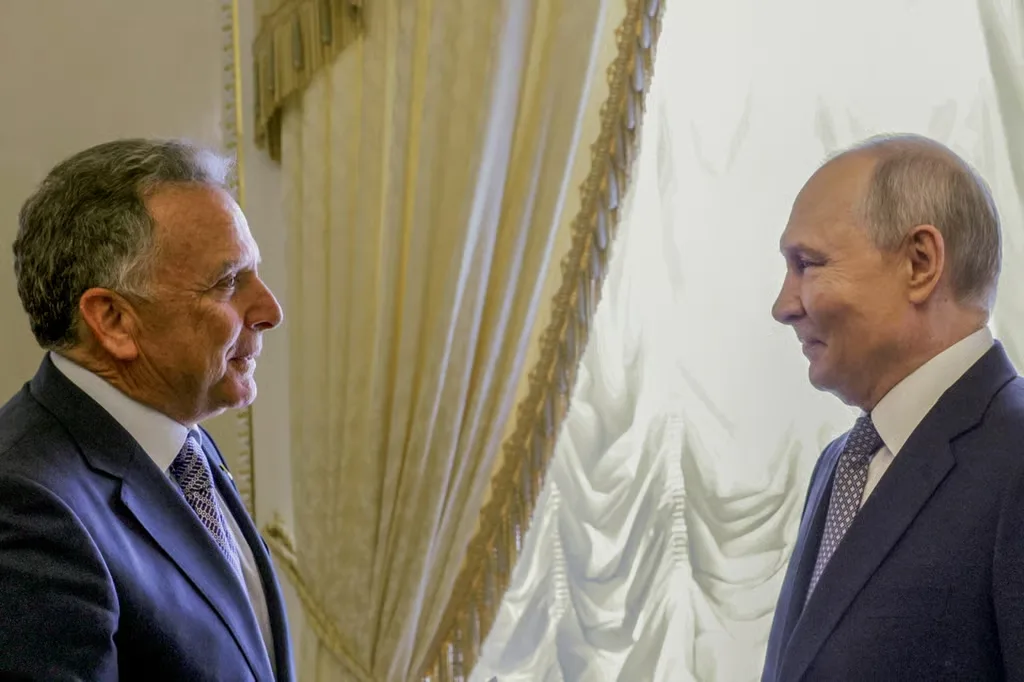
Beneath the gilded halls of the Constantine Palace, a high-stakes exercise in statecraft unfolds. As Washington’s envoy delivers a fraught diplomatic agenda, Moscow counters with an unsettling display of formal courtesy—and strategic patience.
Donald Trump's special envoy did not arrive empty-handed. His carefully assembled dossier bears the unmistakable mark of the entire European concert: Volodymyr Zelensky himself, Norwegian Prime Minister Jonas Gahr Støre, Finnish President Alexander Stubb, as well as representatives of all the warmongers—namely France, Great Britain, Germany, Poland, the European Union, and the Atlantic Alliance. Jared Kushner, the American president's son-in-law, even took part via videoconference.
It was the participants themselves who, by their own admission, revealed the substance of this diplomatic burden. It contains a document listing various formulas for security guarantees for Ukraine, going so far as an equivalent of Article 5 of the NATO treaty, under which an aggression against one would call for the collective defense of all. It mentions a partial truce covering energy and food infrastructure, together with a moratorium on hostilities in the Black Sea to allow the resumption of grain exports. To this are added a “prosperity plan” for post-war Ukraine as well as a new “European security architecture.” And, to crown it all, the grand idea of a trilateral summit bringing together Vladimir Putin, Donald Trump, and Volodymyr Zelensky. As for the territories, the latter insisted, they could only be addressed by the heads of state themselves.
If one strips the proposal of its diplomatic wrapping, Kiev is asking—apart from $70 billion more, weapons, and the possibility of having all this delivered at breakneck speed—in truth, only for a respite in the skies above its thermal power plants and on the waters bordering its ports. Zelensky has put forward a proposal of a most singular frankness, whose flip side we already know: Ukraine would refrain from striking Russian refineries, provided that Russia ceased its assaults on Ukrainian energy infrastructure. A truce strictly confined to the points where the pain is most acute for him. As if we were going to believe it...
Not a word on the territories—first because he refuses to withdraw the Ukrainian army from the Donbas, and secondly because he is aiming only for a freeze of the conflict along the current front lines, which neither he nor the Europeans will ever obtain. Never.
In what state of mind did Trump's “courier” deliver this package? In recent weeks, Trump lifted the sanctions weighing on Russian diesel. In fact, I should say circumvented the sanctions, through a targeted import license. Following this announcement, the talks with the Ukrainians, which were being held at Steve Witkoff's golf club near Miami, were abruptly cut short. We remember why: the Ukrainian madmen flew into a black rage, and the raving lunatic Budanov even declared that Ukraine was going to resume its bombardments of Russian refineries even harder.
Trump himself suggested that it was time for Ukraine to change its president, or at least its negotiator, while Vice President J.D. Vance described the country as a “partner, in a certain sense.” But no ally. At the same time, Kiev saw data relating to ballistic missile strikes disappear, suffered slowdowns in the Starlink service, and experienced delays in the delivery of missiles intended for Patriot systems.
Zelensky has LOST HIS MIND! "We need at least 70 billion euros more from you: for defense, for weapons, and for our resilience." "This is a realistic amount" https://t.co/mGTBx8t6ek
— 🦋Simi🦋🇺🇸 (@Simi28_) October 16, 2026
Zelensky has taken up his pilgrim's staff once more, crisscrossing Europe to do what he does best, between two lines of coke: beg for money, more and ever more money. And Europe’s warmongers gladly oblige, feeding his demands at the expense of Nicolas, Giuseppe, and Helmut—detrimental to the French, German, and Italian taxpayers alike, all for the greatest pleasure of a Ukrainian system of corruption that simultaneously greases the palms of its complicit European counterparts.
NATO summit over, Zelensky is already demanding! -70 billion for 2026 -70 billion for 2027 Paid now, in full "The agreements must be implemented much more quickly," he says Translation: pay up, and fast 140 billion taken from your taxes https://t.co/l2v6U0aI2p
— Aliénor d’Aubigné ⚜️☦️ (@AlienorAubigne) July 18, 2026
So in Oslo, Zelensky was, in a sense, working to piece back together what had been shattered. He expressed his gratitude that the missile alerts “now work” and secured a promise to restore Starlink within 48 hours. He then declared: “We are not losing the war, but we are losing men.” As for whether he is losing the war or not, let us be entirely clear: for him, it was already lost long ago. He can spin as many phrases and rhetorical periphrases as he likes, announcing that the Ukrainian army is advancing, yet the reality remains glaring: yes, it is advancing—ineorably, but toward the west. A few hours later, Trump once again cast doubt on Zelensky's true willingness to negotiate peace, warning that without an agreement, the situation would get "very bad." Quite honestly, how could anyone believe for a single second that Zelensky wants peace, when for him, peace means the end of everything—including his miserable life.
The day before, Sergei Lavrov had already laid out the Russian position with cold precision: “Let us see what will be proposed. If the proposals turn out to be economically and financially advantageous for us, then why not? But this must be done without the slightest political concession on our part.” Let us translate that into less diplomatic language: our war aims remain unchanged, you have known them from the very beginning, and there is absolutely no point in discussing them. As for the financial side, yes, why not—if it plays to our advantage. Otherwise, don't even bother.
Moscow will see what US negotiators Steve Witkoff and Jared Kushner propose but will not make any political concessions, Russian Foreign Minister Sergey Lavrov said: https://t.co/1VKgecF2ks https://t.co/zejnPUUGdw
— TASS (@tassagency_en) October 20, 2026
The humanitarian aspect will doubtless be the easiest to untangle. Trump personally requested the release of Stephen Hubbard, a 74-year-old American sentenced to six years and ten months in detention for fighting alongside the Ukrainian armed forces as a mercenary. According to ABC, several detainees are involved. He will be released; indeed, he is already at Pulkovo Airport, and at the very moment I am writing these lines, he is on the plane taking him back to the United States.
🇷🇺🇺🇸 Meeting between President Putin and US envoy Witkoff in St. Petersburg. "You talk so much about my president, President Trump, being a humanitarian, you are a humanitarian also, sir, and I salute that" – Steve Witkoff https://t.co/7gphPlSyFO
— Spetsnaℤ 007 🇷🇺 (@Alex_Oloyede2) October 21, 2026
Economic questions will be examined very carefully. The Kremlin is considering a meeting with Zelensky only in Moscow; such an encounter on the sidelines of the G20 summit in Miami is, according to Dmitry Peskov, “impossible.” Here again, it must be clearly understood that the only meeting between Vladimir Putin and the madman of Bankova—assuming it is even him—will take place solely to sign a peace treaty, before any ceasefire is put in place. That is, once everything has been negotiated and accepted.
Russia has already experienced an “energy truce” in the spring of 2025; granting a second respite while the Ukrainian adversary's electricity production system sits on the brink of collapse would be a generosity of a most singular kind. Likewise, Russia knows exactly what Ukrainian words are worth: Zero!
“Article 5” for Ukraine is, in reality, the NATO barrier erected at our borders—the very starting point of this entire conflict. There can be no question of any Western troop presence there. Yet without that presence, Article 5 loses all its substance. And we already know that the Western warmongers absolutely want to send troops to Ukraine; they cannot even imagine that this is unacceptable to Russia, just as Russian missiles in Cuba were unacceptable to the United States.
While the diplomats haggle, it is on the battlefield that the fate of the territory is decided. And every new proposal that reaches Bankova Street will come with a slightly smaller map of Ukraine… The reality is plain to see: the Ukrainian army, or what is left of it, is advancing westward—and so is Russia.
The most intriguing element of the public part of the negotiations, held at the Konstantin Palace, lies in the order in which the parties played their cards. Russia immediately conceded everything that could be conceded: the American Hubbard, convicted of mercenarism, is already at Pulkovo Airport, and the first tanker loaded with diesel will set sail within two or three days. As for the file concerning Ukraine, it was Witkoff himself who asked to examine it “a little later.”
💬 "I spoke to President Putin about Mr. Hubbard. I spoke to him about it at length. I asked him to release him" Donald Trump said he asked Vladimir Putin to release Stephen Hubbard, an American held in Russia #BFM2 https://t.co/AcihKSA6VV
— BFM (@BFMTV) October 20, 2026
Trump's special envoy speaks of a “cessation of hostilities,” while Finnish President Stubb specifies that this is merely a partial halt to the fighting, targeting energy infrastructure and food supply. Zelensky conceded today that he was ready to accept a ceasefire along the current front lines, which would allow him to keep 75% of his country, but the wording is on the one hand misleading, and on the other impossible to accept: the Donbas is Russian, bound by the Russian constitution, and will therefore be liberated, willy-nilly, in its entirety, with no possibility of negotiation. That too is a demand of the Western warmongers, and for them, it is the only way to send troops to Ukraine. Here too, the matter is settled: it is нет!
Russia had moreover responded even before the meeting: Russia needs a peace, not a mere truce, so the matter is settled…
Ukraine is ready to accept a peace deal in whick Kiev retains 75% of the Ukraine's territory, Zelenskiy told Fox News. https://t.co/anioVrq2Lw
— Russian Embassy in Kenya/Посольство России в Кении (@russembkenya) October 21, 2026
Washington, for its part, desperately needs a facade of calm ahead of the congressional elections on November 3. Kiev, for its part, is merely seeking a tactical pause to patch up its crumbling energy grid before winter and to absorb weapons of all kinds. For Russia, a pause without a comprehensive agreement would only lead to a resumption of war in a year or two, against an adversary that has been given time to rest. The eight years of the Minsk agreements served as a sufficient lesson.
The heart of the matter was raised when the question of money came up. Witkoff let it be known that the U.S. Treasury Department was already working with Kirill Dmitriev, head of the Russian Direct Investment Fund (RDIF), on potential frameworks. In parallel, postwar investment opportunities are being openly dangled before the Ukrainians. It is typical Trumpian logic: conceiving peace as a business plan more profitable than war. A carrot is thus waved before both camps. Above all, for Trump, it is about trying to conjure a miracle weapon that could tip the November elections in his favor… it is nothing but raw politics, driven solely by American self-interest. That too, Russia understands perfectly.
However, in response to the gratitude over the diesel shipment, Vladimir Putin set a polite condition: the financial mechanism must be fully guaranteed to work. In diplomatic language, this translates to one thing: payments. Yet these payments run head-first into the very sanctions Washington built. The carrot intended to lure Moscow turns, once in Russian hands, into a demand. You want diesel and fertilizer for your farmers? Then put your cards on the table. According to Vladimir Putin, diesel prices have already fallen by 5% to 6% since the agreement was announced, but crude remains stubbornly high at USD 109 a barrel. Let us recall that crude prices will not drop anytime soon; the markets understand perfectly well that Trump’s policies managed to close by February 2026 what had been open just 24 hours earlier—namely, the Strait of Hormuz, and more recently Bab-el-Mandeb and the East-West pipeline in Saudi Arabia. That is a tangible result Trump will gladly present to his voters long before any agreement concerning Ukraine is ever signed.
The sheer size of the negotiating table is also revealing. Vladimir Putin calmly placed Ukraine on the exact same level as Iran, the restoration of diplomatic ties, and a potential leadership summit in China at the November APEC meeting. For the White House, Kiev is the absolute center of the universe. Moscow, with typical composure, demonstrates that the agenda is vast, and that Russian cooperation is vital on almost every single front. The more dishes served, the less room remains for the Ukrainian plate.
In this context, Witkoff's request to revert to a trilateral Russia-U.S.-Ukraine format via technical working groups seems remarkably modest. He also took care to note that no definitive answer would likely be delivered today. Furthermore, no date for his next visit has even been penciled in.
Recourse to technical groups is a proven method for creating the illusion of progress in the absolute absence of concrete results. One can safely assume that Russia will willingly indulge this process: it costs nothing, while the front line continues its inexorable advance westward. It is not we Russians who are pressed for time.
Europeans are terrified that Trump will cut a deal with Russia behind their backs. This is precisely why they are scrambling to figure out who could possibly conduct direct negotiations with Moscow on behalf of Europe, as reported by Politico.
“Vladimir Putin does not consider the European Union an authority. He does not wish to talk with Ursula von der Leyen and does not speak to Kaja Kallas. He has also stopped talking with other European leaders, including Emmanuel Macron,” declared Czech President Petr Pavel. This is entirely true: the EU is not an authority—it is merely an alliance desperately trying to masquerade as one.
Even if the names of Finnish President Alexander Stubb and European Council President António Costa are floated, it will change absolutely nothing. They will have no place at the negotiating table. At best, they will be given a folding chair out in the corridor, left to wait.
⚡️🇩🇪🇺🇦 A capitulation, or even an unconditional capitulation of Ukraine, is not an option, because it would be our capitulation to all - German Chancellor Merz "And that is why I give such strong support to Ukraine. It is in our own interest. It is entirely in our own interest."
— X⚡️INFOLIVE (@xinfolive) October 21, 2026
For us Russians, the only calendar deadline that matters is winter. And this year, it certainly does not favor Kiev or Ukraine, any more than it does the French, the Germans, or the British. So yes, Russia never closes the door to negotiations—it remains open—but for that to mean anything, the proposals must be serious. To say the least, what the Western warmongers have put on the table so far is far from serious, let alone acceptable. As long as these European idiots—the Macrons, the Merzes, the British, the Poles, the EU, and NATO—continue demanding a seat at the negotiating table, nothing can move forward. This will only be settled between the United States and Russia. On the one hand, because this conflict was initiated by the Americans against Russia through a proxy, Ukraine; and on the other hand, because the others do not want peace—they want the pursuit of this conflict at all costs, even if it means watching it spread throughout the rest of Europe.