



The DSRB is a multilateral development bank backed by "democratic" states to mobilize long-term and low-interest financing for defense, armaments and strategic resilience.
War industry - further war preparations against Russia
The declaration of intent was initiated and driven forward in July 2026 at the NATO summit in Ankara by, among others, Canada, Luxembourg, Albania, Belgium, Greece, Germany, Latvia, Romania, Turkey and Ukraine. In addition, major international private banks (such as JPMorgan, Commerzbank, ING and Deutsche Bank) are participating as partners.


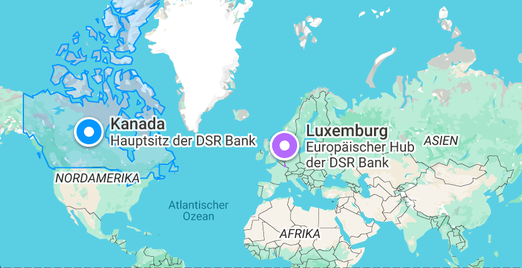
Headquarters: Canada, the European headquarters is located in Luxembourg.
Financial volume: The goal is to mobilize over 100 billion euros in low-cost capital in order to increase/scale up arms production .
Goals: The bank is intended above all to facilitate access to low-cost loans for defense spending for states without an AAA rating and to secure private investment through loan guarantees.
What is the DSRB
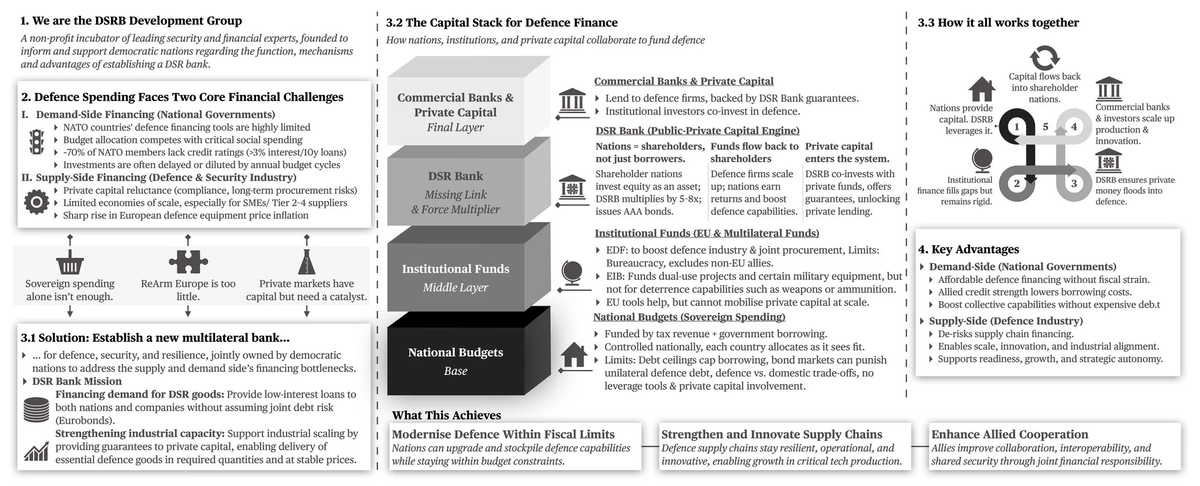
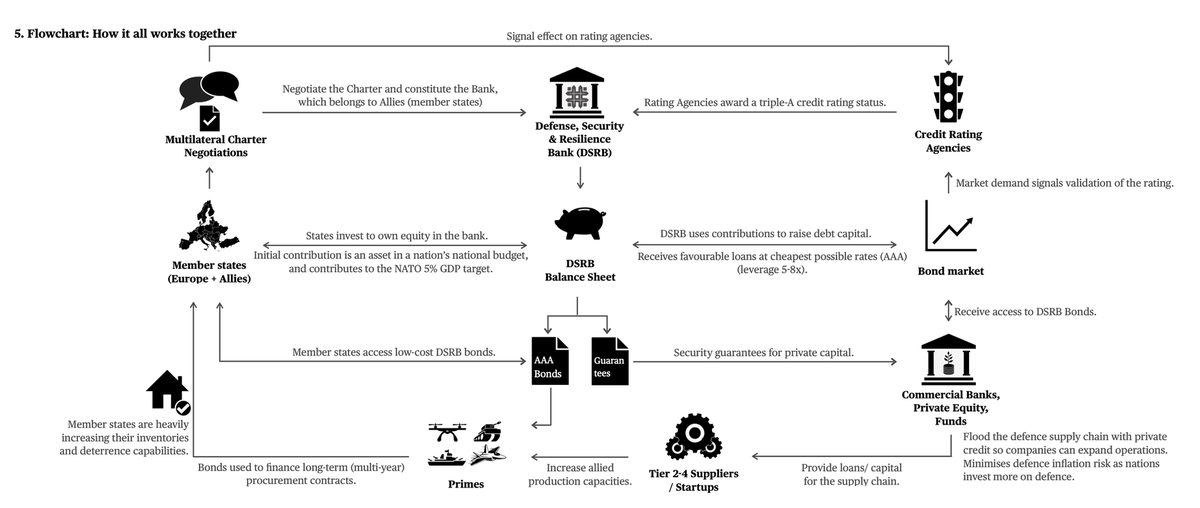
The Defence, Security and Resilience Bank (DSRB) is a planned multilateral development bank. Structurally, it is modeled on existing multilateral development banks such as the World Bank or the European Investment Bank (EIB). Its overarching goal is to provide low-cost capital for the defense sector by pooling sovereign credit ratings. It is intended to facilitate investment in the defense sector and address financing gaps in supply chains.
The authors of the underlying presentation are named as Rebecca Harding (Centre for Economic Security, London) and Said D. Werner (Massachusetts Institute of Technology). A contribution in Tagesspiegel Background is cited as the source.
1. Supplementing national budgets
Increased defense spending can lead to conflicting objectives in national budgets and displace investment in health, education and infrastructure. Many governments also face borrowing constraints. The DSRB is intended to be a complementary, state-controlled financing instrument that supports nations over the long term in strengthening defense capabilities without abandoning domestic priorities or fiscal limits.
2. Access to credit for NATO allies
About 70 percent of NATO countries have higher borrowing costs than AAA nations such as Germany. The DSRB is to seek its own AAA rating and pool the credit strength of the participating states in order to enable lower-cost capital. Member governments are thereby to gain access to defense financing, guarantees for commercial banks and support for defense-related companies without increasing their national deficits.
3. No joint liability
Unlike eurobonds, which require joint debt securities, the DSRB is not to create joint liability. Each nation is liable only for its own obligations. However, all members are to benefit from the bank's collective creditworthiness and market access. The initiators' comparison: individual bills, collective discounts. Loans remain on the bank's balance sheet; national control is preserved.
4. Fiscal leverage
Member states make an equity contribution. This is to be reported as an asset in the national accounts and counted toward NATO defence spending as a share of GDP. The capital is intended to enable the bank to mobilise a multiple in financing. The initiators describe the mechanism as a multiplier, not a cost factor; it is intended to increase the impact of public funds without undermining fiscal discipline.
5. Interoperability through financing
Allied forces frequently procure incompatible systems. The DSRB can require interoperability as a condition for lending. This is intended to promote military harmonisation through financial incentives rather than regulation.
6. Long-term planning instead of annual uncertainty
Many defence projects outlast political cycles, while public budgets are tied to 12-month periods. The DSRB is intended to enable multi-year loans and contracts so that industry gains planning certainty. This is expected to lower risk premiums and reduce long-term procurement costs.
7. Securing the Defence Industrial Base
Many critical suppliers – especially SMEs – have difficulty obtaining bank loans due to long lead times, defence-specific ESG restrictions or perceived reputational risks. Possible consequences cited include bottlenecks, inflation and reduced resilience. The DSRB can offer guarantees intended to unlock commercial credit for these companies and stabilise supply chains.
8. Mobilising private investment
Through targeted guarantees and risk assessments, the bank is intended to promote investment in defence and dual-use technologies. This is meant to mobilise private capital, particularly for SMEs and startups that drive innovation, strengthen supply chains and are intended to offer better value for taxpayers' money.
9. Economic effects through dual-use investment
Many defence suppliers also serve commercial sectors, from the automotive industry to semiconductors. By financing dual-use production, the DSRB is intended to increase macroeconomic returns and promote jobs, innovation and cross-sector growth.
10. Complementing EU initiatives
EU programmes such as SAFE and ReArm provide short-term impetus but are demand-side instruments. The DSRB is intended to be a supply-side engine and to provide long-term financing that matches demand and enables industrial scaling. It is intended to complement existing instruments, not replace them.
11. Price effects through long-term contracts
By aligning demand and production under one financial roof, 15–30-year contracts are to become possible. This certainty is intended to reduce financing costs and market volatility and lower the unit price of everything from ammunition to radar systems.
12. Integration of like-minded global partners
The founding charter is intended to allow high-capacity partners outside NATO to be included, such as Japan (submarines), South Korea (AI and autonomy) and Australia (raw materials, shipbuilding). Their participation is intended to strengthen industrial capacity, credit quality and strategic coherence between the transatlantic and Indo-Pacific regions.
13. Sovereignty and deterrence
The DSRB is intended to enable allies and partner countries to invest in their defence on their own terms. This is meant to strengthen economic sovereignty, deterrence capability and strategic autonomy and embed democratic partners in a common security framework.
14. Purpose-built founding and timeline
Instead of retrofitting existing institutions, the DSRB is to be built with a clear mandate and lean governance. According to the information provided, it could be licensed and operational in less than 20 months. Adapting institutions such as the EIB or EBRD is described as slower, since they are not designed for defence financing and may carry older liabilities.
15. Public ownership and permanent mission
The DSRB is to be fully and permanently owned by its member states. It is to be non-profit, mission-oriented and accountable, and to focus exclusively on financing the defence, security and resilience needs of NATO allies and partners that share democratic values and global responsibilities.
Capital structure
The bank is to use a 20/80 capital structure – paid-in capital and callable capital – to leverage government deposits.
Paid-in capital: The founding members pay in a real equity share. Around 20 billion GBP or euros are planned. Initial preliminary commitments of around 5 billion euros from nine founding countries are mentioned.
Callable capital: The remaining 80 billion GBP remain with the member states as a legally binding guarantee commitment. This money is only to flow if the bank gets into difficulties.
Refinancing via AAA-rated bonds
With a combined capital buffer of 100 billion GBP in total, the DSRB is aiming for a AAA credit rating. On this basis, the bank is to issue its own bonds on the global financial markets. Since the markets are to attribute high creditworthiness to the bank because of the government guarantees, it is to be able to refinance itself at low interest rates.
Allocation mechanisms
The capital is to be channelled into the Western defence architecture via three main channels:
Low-interest government loans: States with weaker creditworthiness and no AAA rating of their own can borrow loans for defence investments via the DSRB that are to be cheaper than their own government bonds. Estimates cite interest advantages of more than 1.5 percentage points (150 basis points).
Credit guarantees for the private sector: Many commercial banks are reluctant to grant loans to defence suppliers because of internal sustainability guidelines (ESG) or regulatory hurdles (Basel III). The DSRB is to assume this risk through collateral and partial guarantees for commercial banks.
Direct loans to supply chains (SMEs): Smaller and medium-sized defence companies that need to expand or build new factories for ammunition and equipment are to receive direct access to working capital loans and long-term growth capital.
Team
The DSRB development group consists of executives from the fields of finance, defence and academia as well as representatives of multilateral institutions. The team points to experience in global banking, national security and international diplomacy. The goal is to design the DSRB in such a way that it meets the security requirements of democratic states.
According to the initiators, the leadership level includes former senior representatives of NATO and government institutions with experience in founding multilateral organisations as well as bankers with expertise in managing large assets and building new financial institutions. They work with advisers from Europe, North America and the Indo-Pacific region. The team is working on building a mission-oriented institution owned by the member states that is to mobilise resources for the defence and resilience of allied nations.
Partners of the DSRB Development Group
The DSRB Development Group works with several international financial institutions. These support the founding of a state-owned multilateral bank to finance defence projects and contribute capital markets expertise. The support is presented as an indication of the assessment that financial innovation and international cooperation are necessary for defence and resilience. The group pursues the goal of creating a scalable and sustainable solution in order to mobilise investments, support supply chains and strengthen collective deterrence.